Inflation drives more Wisconsin college students to food pantries
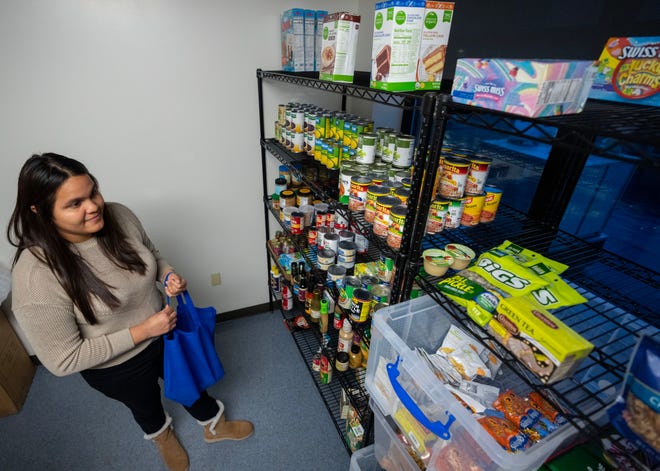
Student Pamela Delgado selects items from a food pantry at MATC's Walker Square campus, 816 W. National Ave., in Milwaukee The pantry opened Tuesday.

A ribbon-cutting event for a former storage room marked a milestone for Milwaukee Area Technical College.

MATC converted the small space at its Walker’s Square campus into a food pantry that opened Tuesday. It’s the last of MATC’s five campuses to open a food pantry for students, all of which were launched within the last year.

The pantries couldn’t have come at a better time.

Soaring food costs have college students feeling the pinch. The need is especially great at Walker’s Square, which is on the near south side in the heart of Milwaukee’s Latino community. Many students at the campus are enrolled in the GED or English as a Second Language programs while working minimum wage jobs that don’t provide enough to cover rent, gas, groceries and other expenses.

Equan Burrows, MATC’s dean of student experience, said the college had previous iterations of food pantries, such as donated canned goods stocked in the corner of a room or breakfast bars slipped to hungry students.

But he said MATC’s partnership with Feeding America is more formalized and ensures the school’s long-term commitment to addressing food insecurity, a relatively widespread problem plaguing community colleges in which students don’t have the resources to feed themselves nutritiously, or even at all.

“This is groundbreaking,” Burrows said about the opening of pantries at every MATC campus. “And this is something we can sustain.”
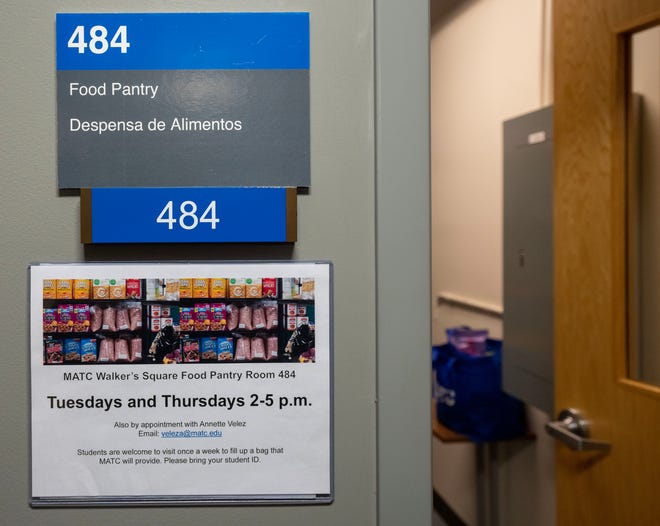
The entrance to a food pantry is shown Tuesday at MATC's Walker Square campus.  Food pantries are located on each MATC campus.

The need for the food pantries at MATC is ‘higher than anticipated’

A survey conducted by Temple University’s Hope Center for College, Community and Justice illustrates the immense need for food pantries at MATC. Half of the school’s nearly 2,700 survey respondents reported experiencing food insecurity in the previous 30 days. That’s higher than the 39% of two-year students facing food issues nationally.

MATC opened the first food pantry at its downtown campus in November 2021. What started as a 500-pound weekly food order has grown to a 1,400 pound order — and that’s without accounting for the addition of the Walker’s Square campus.

At the downtown campus pantry alone, more than 1,200 visits have happened so far this semester, said Haley Weber, whose job as MATC’s coordinator of student services is to remove barriers students face to earning their degrees. In addition to non-perishable items for pickup, the main campus also offers about 200 hot meals per week made by culinary programs students using leftover food that would otherwise have gone to waste.

“The need has been even higher than anticipated,” she said. “Some students come every single day for lunch.”

The cost to the college is minimal, maybe $600 a month, Weber said. If Feeding America has a week in which donations are low, MATC buys food from the nonprofit at a reduced price.

The benefits of campus pantries are vast. Food insecurity is fundamentally a retention issue. Students without enough to eat are unlikely to be able to stay in school.

Among MATC’s pantry shoppers was Ivonne Ruiz, a full-time student in the English as a Second Language program. With food prices so high, she said she limits what she buys to the bare essentials. The campus pantry helps supplement her groceries.

Another shopper who visited a MATC pantry at least once a week was a mom who said she didn’t receive enough food stamps to feed herself and her three children.

Colleges and universities across Wisconsin seeing similar trends

Colleges across Wisconsin are hearing similar stories at their pantries: more visits and more students, which all of the schools attributed primarily to higher grocery prices.

At Madison Area Technical College, 464 student visits took place in the first three months of the fall 2021 semester, said student health educator Denise Holin. The same time period this fall brought 613 visits.

More than 1,000 Waukesha County Technical College students picked up bags from the school food pantry in 2019, said Stephanie McWilliams, the assistant director of student life. Since August, the school opened a second pantry location and has already handed out nearly 600 bags.

While food insecurity hits Black, first-generation and two-year college students are the hardest, four-year schools are also seeing stronger demand.

At the University of Wisconsin-Milwaukee, basic needs coordinator Allie Dorshorst said the spring 2022 semester brought about 100 students to the pantry per week. This fall, UWM is seeing an average of 230 students weekly. Inflation was a factor in the uptick, though she also said the school expanded its hours.

UW-Green Bay recorded roughly 150 visits per month before the pandemic, said Stacie Christian, the assistant vice chancellor of inclusive excellence. That increased to about 250 visits last spring and the pantry this fall is approaching an average of 400 monthly visits.

Contact Kelly Meyerhofer at [email protected]. Follow her on Twitter at @KellyMeyerhofer.

Read More

How the Dutch took the lead in food tech and sustainability

The tiny country of the Netherlands has become a leader in developing technology for sustainable farming. Not only is it becoming a major exporter of food in Europe, it’s also a model for other nations in how to minimize waste and water use, said Laura Reiley, who reports on the business of food for The Washington Post.

“Marketplace” host Kai Ryssdal spoke with Reiley about Dutch advances in vertical farming and raising crops and livestock with reduced carbon dioxide emissions. The following is an edited transcript of their conversation.

Kai Rysdal: OK, so this is a food story. Yes. But really, it’s a technology story. It’s a crazy technology of food story.

Laura Reiley: Absolutely, kind of a shock-and-awe visual smorgasbord.

Rysdal: Well, tell me how you came upon this story, because we should say up front, you know a little bit about food. I mean, you’ve been a professional chef, you’ve, you know, got awards and all that jazz. And here you’re now reporting on it. What got you into this story?

Reiley: Well, I was riding the coattails of this fabulous Dutch photographer, Kadir van Lohuizen, but he was looking at how this very tiny European country is the second largest exporter of agricultural products by value in the world behind the US So, you know, they ‘re doing an awful lot of raising animal and vegetable production and seed production on very little land.

Rysdal: Yeah, we should be clear here, it’s across the gamut of ag, right? It is livestock, it is ornamental vegetables and seeds, as you say. It’s, I mean, it’s everything that they’re doing. And they’re doing it on, not to be pejorative here, a relative postage-size stamp of land.

Reiley: Yeah, you know, half of the land in the country is devoted to ag. But an interesting thing is about 24,000 acres — so about double the size of Manhattan — is under glass, and it’s greenhouses. I mean, if you’ve ever flown over the northern part of the country, not that far from Amsterdam, it looks like something out of “Blade Runner,” you know, it’s just these, like, incredible vistas of sparkling glass . So a lot of what they’re doing is what we call now indoor vertical — there’s a bunch of different terms for that. A lot of what they’re doing is also developing the technology that can be exported to other places. And what’s great about that is that it can make the farms close to where the people live, and in parts of the world where there isn’t arable land.

Rysdal: Yeah. And big multinationals are going over there to learn how to do it.

Reiley: Absolutely. I mean, I think that there’s an awful lot of interest right now in upping our game in terms of technology, a lot of VC money and food tech right now. But some of what the Netherlands is doing is more kind of old-school, regenerative ag, or, you know, minimizing waste and water use. So it’s very kind of climate friendly, high-tech ag.

Rysdal: Say more about that, right? Because among the other things that they are doing is they’re doing all of this production without increasing natural gas use, without increasing CO2, reducing fertilizer, using all of this stuff that, you know, is going to be key as we try to deal with a warming planet.

Reiley: Sure. So they’re huge producers of onions and tomatoes, and they can produce a pound of tomatoes requiring only half a gallon of water. And the average globally is 28 gallons. So, you’re seeing a real discrepancy —

Rysdal: Say that again, because that’s wild.

Reiley: Yes, so on average over the world is 28 gallons of water to produce a pound of tomatoes. In the Netherlands, it’s a half gallon, so none of that water is wasted. And the irony is that, you know, a generation ago, they had a terrible reputation. They were just these hard bullet balls that no one wanted to eat. And so they’ve really kind of changed their reputation. And not just on the vegetable side, but also on animal ag. So, chickens, beef pigs, they’re huge exporters, now the biggest European exporter, and a lot of those ribs come to kind of middling chain restaurants in the United States. So you’ve probably — I’m not going to name names, but you’ve probably eaten some of them unknownst to you.

Rysdal: Look, I mean, you got to use a whole animal, right? Let me ask you this: You have certainly driven up and down California’s Central Valley, right? And seen all the agriculture there, huh?

Reiley: Oh, absolutely. Yeah.

Rysdal: All right. So, how long do you think it’s going to be given Big Ag in

Read More

Samaritan’s Purse crosses the threshold of 100M pounds of food distributed in war-torn Ukraine

Samaritan’s Purse, the North Carolina-based international Christian relief and evangelism organization, has achieved a significant milestone: It has just crossed the threshold of 100 million pounds of food distributed in the war-torn country of Ukraine.

The organization shared the update with Fox News Digital on Monday.

Every week since the Russia-Ukraine conflict began on Feb. 24, the charitable group has been flying relief supplies and food to Ukraine for the scores of innocent people caught in the crosshairs of war.

SAMARITAN’S PURSE ASSEMBLES DISASTER RELIEF TEAMMS TO HELP UKRAINIAN REFUGEES

Rev. Franklin Graham, CEO and president of Samaritan’s Purse, told Fox News Digital on Monday, As winter sets in, things in Ukraine are only getting worse.”

He said that “many areas have lost electricity and food is impossible to buy in eastern parts of the country [that are] closer to the fighting.”

A man in Ukraine carries a bag of food distributed by Samaritan's Purse.

A man in Ukraine carries a bag of food distributed by Samaritan’s Purse.
(Samaritan’s Purse)

He added, “Samaritan’s Purse has been buying and bringing food into the country every week. We are also receiving food from the World Food Program.”

As of this week, Samaritan's Purse has distributed more than 100 million pounds of food — or over 45,000 metric tons — to the people of Ukraine caught up in war.

As of this week, Samaritan’s Purse has distributed more than 100 million pounds of food — or over 45,000 metric tons — to the people of Ukraine caught up in war.
(Samaritan’s Purse)

Added Rev. Graham, “As of this week, we have distributed more than 100 million pounds (over 45,000 metric tons). We are working with our network of churches across Ukraine to distribute this food to people in need and remind them that God loves them.”

“We need to continue to pray that God will work in the hearts of the leaders involved to bring an end to the conflict that has brought so much pain and devastation,” he said.

Monday, Dec. 5, 2022, marks day no. 285 in the war between Russia and Ukraine.

Every week, Samaritan's Purse imports 1.4 million pounds of food into Ukraine, the organization said.

Every week, Samaritan’s Purse imports 1.4 million pounds of food into Ukraine, the organization said.
(Samaritan’s Purse)

Each week, Samaritan’s Purse has been bringing 1.4 million pounds of food to Ukraine, it was reported.

“Stores and shops have closed, leaving no way for people to buy food.”

On Monday, it reached the major threshold of having distributed 100 million pounds of food.

UKRAINE BEGINS NEW EVACUATIONS IN KHERSON AS INCREASED HOSTILITIES EXPECTED

The organization said that in dangerous areas, “stores and shops have closed, leaving no way for people to buy food.”

Samaritan's Purse has been helping the people of Ukraine since the earliest days of the war.

Samaritan’s Purse has been helping the people of Ukraine since the earliest days of the war.
(Samaritan’s Purse)

Many of the people “desperate for food can only take what they can carry – so the food is given to people in grocery bags,” he said.

The group also told Fox News Digital, “Some of the brave pastors and church leaders that we are partnering with are also taking these food distributions into the conflict zone. They face dangerous conditions to reach distribution points.”

Rev.  Franklin Graham (at right) was shown earlier this year in one of the medical clinics his organization set up in Ukraine amid the war.

Rev. Franklin Graham (at right) was shown earlier this year in one of the medical clinics his organization set up in Ukraine amid the war.
(Samaritan’s Purse)

The organization continued, “These unsung heroes take buses, vans and even their own vehicles loaded with food and other relief supplies from Samaritan’s Purse to people who are suffering deeply in the conflict.”

CLICK HERE TO GET THE FOX NEWS APP

The pastors “also offer to help those residents who are evacuees — and some people have been able to get to safety through these missions.”

Rev. Graham himself has visited Ukraine twice since the conflict began. He is hoping to return sometime in January, the group said.

CLICK HERE TO SIGN UP FOR OUR LIFESTYLE NEWSLETTER

Both sides in the war have been taking hits, as explosions rocked two Russian air bases on Monday and multiple Ukrainian cities sustained damage from missiles, The Wall Street Journal reported.

In Ukraine, people flooded into bomb shelters, including shelters set up in the underground transit system, as Russia rained missiles down into the country.

Ronn Blitzer of Fox News Digital contributed reporting.

Read More