Botulism from food causes the death of a respected outdoorsman from Jackson Hole

Wyoming social media reports the death of 55-year-old Hans Russell, who succumbed to botulism after being conscious but also completely paralyzed for several weeks in a Salt Lake City hospital.

Russell was a popular outdoorsman and river guide in Jackson Hole, WY. His death is blamed on a solo camping trip to Idaho where he consumed a can of soup that was not properly refrigerated. The doctors in Salt Lake City who fought to keep him alive came to believe that the single can of soup was the source of the botulism toxin Russell consumed.

Russell was well known in Jackson Hole. He was a kayaker, paraglider, rock climber, fisherman, and guide for Mad River Boat Trips and a bus driver for Lewis and Clark Expeditions. He was an expert in the whitewater areas of Wyoming and Idaho who always put safety first

He was from Pittsburg, KS, and became attached to the Yellowstone/Teton area after high school. He did return to Kansas to pick up an Arts Degree from Pittsburg State University. His friends say he was also “an amazing guitarist.”

The botulism-contaminated soup that led to Russell’s paralysis and death was said to have trapped him in his own body in that he could not move and was called a nightmare that began with a can of soup.

The outdoor enthusiast, river runner, and guide was diagnosed with Botulism A, a rare bacterial infection that undermines the body’s nerves and prevents breathing and paralysis of muscles. It left Russell unable to talk or open his eyes.

He was a Jackson Hole resident for the past 10 years. His death was first reported on the GoFundMe page that friends were using to help pay Russell’s hospital bills.

About botulism
While a variety of food poisoning can result from eating under-processed food, one of the most dangerous is botulism poisoning. Untreated, botulism can paralyze the muscles needed for breathing, resulting in sudden death.

Anyone who has eaten any recalled products and developed signs of botulism poisoning should immediately seek medical attention, according to the US Centers for Disease Control and Prevention (CDC).

“In foodborne botulism, symptoms generally begin 18 to 36 hours after eating contaminated food. However, symptoms can begin as soon as 6 hours after or up to 10 days later,” according to the CDC website.

The symptoms of botulism may include some or all of the following: double vision, blurred vision, drooping eyelids, slurred speech, difficulty swallowing, difficulty breathing, a thick-feeling tongue, dry mouth, and muscle weakness. People with botulism poisoning may not show all of these symptoms at once.

These symptoms result from muscle paralysis caused by the toxin. If untreated, the disease may progress, and symptoms may worsen to cause paralysis of specific muscles, including those used in breathing and those in the arms, legs, and the body from the neck to the pelvic area.

(To sign up for a free subscription to Food Safety News, click here.)

Read More

Purina’s Mislabeling Triggers Limited Recall of Prescribed Wet Dog Food

dog eating wet dog food from bowl;  Purina Pro Plan recall

dog eating wet dog food from bowl; Purina Pro Plan recall

Brie Goldman

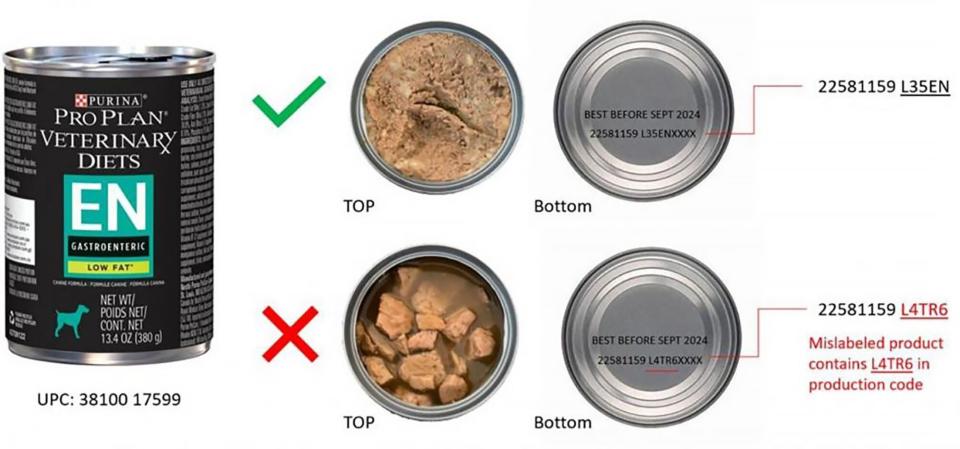
Purina is recalling a small amount of low-fat wet dog food after cans of a completely different food were labeled incorrectly.

Nestlé Purina PetCare Company announced last week that it’s voluntarily recalling some of its Purina Pro Plan Veterinary Diets EN Gastroenteric Low Fat (PPVD EN Low Fat) food because those can might hold another product.

According to Purina, some cans of Purina ONE True Instinct Tender Cuts In Gravy With Real Turkey & Venison were mistakenly labeled as the gastroenteric low-fat food on Sept. 15. Nothing is wrong with the food—it’s safe for dogs to eat—but it’s obviously not the low-fat food some pups are prescribed.

RELATED: FDA Urges Customers To Toss Out Salmonella-tainted Raw Cat Food. Not So Fast, the Manufacturer Says

Pet owners contacted Purina about the mix-up, and the company said it issued the recall as a precaution. It’s received no reports of sick dogs. Here are the details of the recalled food, which you can find on the 13.4-ounce can.

When you open the can, the low-fat food prescribed should look like a beige paste. The mislabeled food—the turkey and venison—consists of chunks swimming in gravy.

infographic showing the details of which Purina Pro Plan Dog Food has been recalled

infographic showing the details of which Purina Pro Plan Dog Food has been recalled

Courtesy of Nestlé Purina PetCare Company

While there’s nothing wrong with chunky food, Purina says it’s not intended for dogs who are prescribed low-fat food. The chunky food might be hard for them to digest.

Veterinary offices and prescription-validating retailers sold the food, and Purina has urged them to dispose of it. Same goes for any dog ​​parents who have the misidentified food: Toss it, and Purina will replace it.

Anyone affected can contact Purina at 1-800-579-7733 or purina.com/contact-us.

Read More

Higher food prices caused by inflation leads to increased food insecurity for the holiday season

Staffers at Bread for the City, a venerable charity in the nation’s capital, thought they were prepared for this year’s annual pre-Thanksgiving Holiday Helpers food giveaway. The pandemic had faded, but inflation was high, so they budgeted to give out 12,000 meals, 20% higher than normal pre-pandemic levels.

But they were quickly overwhelmed, with long lines of clients waiting hours to receive a free turkey and a $50 debit card for groceries. They were forced to shut down three days early after helping 16,000 people, much more than anticipated.

“We don’t want to retraumatize our community by having them wait outside four hours for a turkey,” said Ashley Domm, the charity’s chief development officer. “We are not set up to have hundreds of people lined up on a city street.”

RAMPANT RETAIL THEFT MAKING WORSE INFLATION, THREATENS BLEEDING BUSINESSSES, ECONOMISTS SAY

Bread for the City’s experience reflects a larger dynamic playing out across the country. What many Americans hoped would be the first normal holiday season in three years has instead been thrown into a heightened hunger crisis once again, with Christmas on the horizon.

A September report by the Urban Institute estimated that about 1 in 5 adults experienced household food insecurity last summer, about the same as during the first year of the pandemic but a sharp increase from the spring of 2021. Black and Hispanic adults reported higher rates of food insecurity than their white counterparts, according to the report.

“In the pandemic, nobody had jobs and nobody had money,” said Nancy Murphy, a 45-year old caregiver picking up a frozen turkey and groceries last week from a giveaway at the Redeemed Christian Church of God New Wine Assembly church in northeast Washington . “Now they’re back at their jobs but the money isn’t going far enough. It’s still hard.”

The government estimates food prices will be up 9.5% to 10.5% this year. And that’s squeezing the budgets of many Americans and the food banks that have helped them, especially with the expiration of the massive flow of pandemic relief aid.

Maria Correa, center, who says she is sick with cancer and cannot work, accepts a turkey and Thanksgiving trimmings during a Thanksgiving food giveaway on Nov.  22, 2022, in Washington.

Maria Correa, center, who says she is sick with cancer and cannot work, accepts a turkey and Thanksgiving trimmings during a Thanksgiving food giveaway on Nov. 22, 2022, in Washington.
(AP Photo/Jacquelyn Martin)

“Inflation has been the story of the year,” said Michael Altfest, director of community engagement at the Alameda County Food Bank in Oakland, California.

Altfest said the level of community need remains 50% to 70% higher than pre-pandemic levels, and about 30% of calls to the food bank’s emergency helpline are from first-time callers.

In multiple cases, charities and food banks had prepared for increased numbers due to inflation, only to find the level of need had far exceeded their projections.

The Capital Area Food Bank in Washington originally projected it would need to distribute about 43 million meals during the July 2022-June 2023 budget year. Now four months into that fiscal year, it is already 22% ahead of those predictions.

“That was an educated prediction with a good four or five months of information,” said the food bank’s CEO, Radha Muthiah. “We are always thinking about Thanksgiving and Christmas right when everybody’s heading to the beach in summer.”

SEE IT: CHRISTMAS TREES WILL NEEDLE BUYERS THIS SEASON WITH PRICES EXPECTED TO RISE

In Illinois, Jim Conwell of the Greater Chicago Food bank says the need remains elevated. “So we’re purchasing more and we’re spending more on what we do purchase,” he said.

His organization’s network served about 30% more households in August 2022, compared to the previous August.

“Families that were just getting their feet back underneath them are experiencing a whole new challenge or even if they have employment, or have several jobs or sources of income, it’s just not going as far as it was two years ago,” he said.

Higher prices are forcing people to make “sacrifices on their food,” Altfest said.

For example, he said, the price of chicken has more than doubled — from 78 cents per pound last year to $1.64 per pound this year. Estimates from the Farm Bureau set the cost of turkey as 21 percent higher than last year. And market researcher Datasembly estimates that a 16-ounce box of stuffing costs 14% more than last year, while a 5-pound bag of Russet potatoes averages 45.5% more.

Mike Manning, president of the Greater Baton Rouge Food Bank in Louisiana, draws a distinction between the increased hunger levels sparked by the pandemic and the current crisis. During the pandemic, millions of people’s jobs and incomes have essentially disappeared, creating an immediate wave of need that he compared to the aftermath of a hurricane.

But the current crisis has been a slow and steady rise, starting in late February and still climbing. Manning said his food

Read More