FDA Says Lab-Grown Meat Is Safe to Eat: What Is It?

“Farm-to-table” has long been a sought-after design for food—but “lab-to-table” might be the next trend for your favorite animal protein.


In a landmark ruling, the US Food and Drug Administration (FDA) has cleared lab-grown poultry for human consumption. On November 16, the FDA stated it had “no further questions” regarding the production of cell-cultured chicken by California’s Upside Foods.


This is the first time a US government agency has approved lab-grown meat, so there are plenty of questions surrounding its production, safety and availability. Wondering what lab-grown meat actually is, whether it’s safe, and when you might expect to see it on grocery store shelves? Here’s what we know so far.


Growing meat in a lab is a different process than traditional farming, to say the least—but the meat it creates is biologically the same as “real” chicken.


At Upside Foods, it all starts with a cell sample from a live chicken (hence lab-grown meat’s alternate names: cell-cultured meat or cultivated meat).


“[We take] a cell sample from an animal or fertilized egg and extract the cells that have the ability to grow into animal tissue or meat,” David Kay, Upside Foods’ director of communications, told Health. “From there, we put those cells into a large stainless steel tank called a cultivator that resembles beer-brewing equipment. We then provide the cells with the nutrients they need to grow and multiply.”


You might think of Upside’s chicken production process as the meat equivalent of growing plants in a greenhouse.


“Cultivating meat enables the same biological process that happens inside an animal by providing warmth and the basic elements needed to build muscle and fat: water, proteins, carbohydrates, fats, vitamins, and minerals,” Maia Keerie, media and communications manager for the Good Food Institute, a nonprofit think tank dedicated to alternative protein development, told Health.


Lab-grown meat has long been a dream in the minds of food innovators, but until now, government agencies have remained largely unclear about its suitability for human consumption. So what exactly does the FDA’s “no further questions” designation mean?


In brief, the FDA’s ruling means that Upside’s lab-grown chicken is safe for humans to eat because it doesn’t differ from regular chicken on a cellular level.


“In its rigorous pre-market safety review of Upside Foods’ cultivated chicken, the FDA did not identify any features of the cells as described that would render them different from other animal cells with respect to safety for food use,” said Keerie.


According to Kay, this ruling reflects Upside’s own determinations about the safety of their cell-cultured chicken.


“This landmark regulatory decision means that the FDA has accepted our safety conclusion, and Upside’s cultivated chicken will be available to consumers following USDA inspection and label approval,” he said.


Granted, eating chicken created in a stainless steel vat may sound a little odd. If you’re skeptical about the prospect of lab-grown poultry, you’re not alone. Some people have even expressed concern that cell-cultured meat could pose unforeseen health risks.


“The Center for Food Safety says that it’s unknown whether lab-grown meat will pose any more or fewer safety concerns than traditional meat,” Ashley Kitchens, RDN, owner of Plant Centered Nutrition, told Health. “There are arguments that, because lab-grown meat doesn’t have a fully functioning immune system, it’s at a higher risk of contamination.”


Still, Keerie contends that lab-grown meat could actually be superior to conventional meat for food safety.


“Antibiotics and antifungal agents are not used at all during the production process (but may be used in very small quantities during the pre-production phases). Therefore, cultivated meat will not contribute to antibiotic resistance and is likely to result in fewer incidences of foodborne illnesses,” she said. “For example, Upside’s cultivated chicken had very low microbial counts compared to conventional chicken and also tested negative for common foodborne pathogens such as Salmonella.”


Keerie also pointed out that many of the diseases humans encounter stem from problematic farming practices. (According to the CDC, three out of four new or emerging infectious diseases in humans come from animals.) Growing meat in a lab, rather than on a farm, could offer a solution.


“To reduce the risk of zoonotic diseases associated with animals, the cells used in cultivated meat production are carefully screened and confirmed to be absent of infectious pathogens including viruses, bacteria and other microbes,” said Keerie.


Besides their potential food safety benefits, engineered chicken and other meats have gotten a buzz for other pluses—most notably, their sustainability factor. Growing chicken meat in a lab uses far less resources than raising live chickens on a factory farm.


“When produced at scale using renewable energy, cultivated meat is projected to generate a fraction of the emissions and require a fraction of the land and water of conventional meat production,” said Kay.


This could
Read More

Food Diary: How a 28-Year-Old Teacher Eats on $50K/Year in Providence, Rhode Island

Welcome to The Receipt, a series documenting how Bon Apétit readers eat and what they spend doing it. Each food diary follows one anonymous reader’s week of expenses related to groceries, restaurant meals, coffee runs, and every bite in between. In this time of rising food costs, The Receipt reveals how folks—from different cities, with different incomes, on different schedules—are figuring out their food budgets.

In today’s Receipt, a 28-year-old English teacher in Providence, Rhode Island who drinks a lot of kefir, considers ruining her intestines to eat gluten, and is very opinionated about Caesar salad. Keep reading for her receipts.

The finances

What are your pronouns? She/her

What is youroccupation? I am a high school English Language Arts (ELA) teacher. During the fall, I worked as an Assistant Scorer for NCAA volleyball games, and in the spring, I coached a high school volleyball team.

How old are you? I’m 28 years old.

What city and state do you live in? Providence, Rhode Island

What is your annual salary, if you have one? $50,253, as a Level 2 teacher with Master’s. Level 2 is my salary step and year in teaching, so it means that I am a second year teacher. I have a Master’s of Education in Urban Teaching from Providence College, where I worked as a Graduate Assistant for the Black Studies Program.

How much is one paycheck, after taxes? $1,293.45

How often are you paid? (eg weekly) Biweekly

How much money do you have in savings? I have almost $1,000 in savings.

What are your approximate fixed monthly expenses beyond food? (ie rents, subscriptions, bills)

  • Rent and utilities: Close to $1,000
  • gym memberships: $60
  • Canva subscriptions: $12
  • Apple Music: $5
  • credit card bills: About $200
  • Total: $1,277

The diets

Do you follow a certain diet or have dietary restrictions?
I’m Muslim, so I don’t eat pork. I drink alcohol very rarely. Food allergies are the bane of my existence; I can’t eat gluten, garlic, almonds, hazelnuts, jicama, jackfruit, cherries, or kiwi.

What are the grocery staples you always buy, if any?
I’m always buying kefir, yogurt, granola, coffee, half and half, arugula, mushrooms, bananas, rice cakes, dates, eggs, deli meat, rice and lentils.

How often in a week do you dine out versus cook at home?
I typically eat out one to three times a week.

How often in a week did you dine out while growing up?
My family would have “Junk Food Mondays” when my parents would go to a fast food restaurant and pick up dinner. Once in a while, my grandpa would take us out for dinner, or we would go somewhere as a family for special occasions. Kabob and Curry, Andrea’s, and East Side Pockets are three places in Providence where we would get take out from once in a while. My family has been eating at those restaurants for more than 20 years. Being a regular is nice, because they know we like a lot of extra sauce.

Read More

3 Outstanding Food Swaps to Improve Brain Health

Tetyana Kovyrina/Pexels

Source: Tetyana Kovyrina/Pexels

Research over the last decades has made it abundantly clear that what we eat plays a major role in our overall, and especially, brain health. For example, we know that people who eat certain patterns of diet (like the Mediterranean or MIND diets) may be protecting themselves against conditions like Alzheimer’s, dementia, and depression. We also know that inflammation in our brains (driven in part by unhealthy diets) may have the opposite effect. Yet often, it’s tough to make an abrupt change from an unhealthy diet to a healthy one. With this in mind, making some simple food swaps is a great way to ease into a brain-healthy diet. Here are three easy ways to subtract dietary junk in favor of healthier alternatives for your brain.

1. Swap processed meat for fish and unprocessed alternatives

Most of us have heard that excessive red meat consumption may be bad for our bodies. On the other side of the spectrum, the rising popularity of diets like the “carnivore” diet has others wondering if there are health benefits from eating more meat.

What does the research actually say? Although the picture is somewhat muddy, several larger studies have shown that when it comes to brain function, it’s the processed meat we want to avoid. For example, an observational study of nearly 500,000 people showed that consumption of processed meat (think hot dogs, chicken nuggets, and many deli meats) was linked to a higher risk for dementia, while eating unprocessed beef, lamb, and pork had the opposite effect .

Want to take it one step further? Seafood, especially omega-3 rich fish, like wild salmon, may be even better for long-term brain health. In a meta-analysis of over 30,000 people published in 2022, researchers found people eating more seafood had a significantly lower risk of developing dementia.

2. Swap out the refined carb snacks for nuts and seeds

One important signal in recent dementia research concerns the connection between metabolic health and brain health. In brain scans of people with dementia, like Alzheimer’s disease, there’s evidence that the brain has trouble using glucose for fuel. This is linked to something called “insulin resistance,” a condition in which our bodies (and potentially our brains) develop problems with blood sugar management.

So how does insulin resistance develop? A major contribution is thought to be the excessive consumption of foods that spike blood sugar, and processed snacks rich in refined carbohydrates (for example, crackers, chips, cookies, pretzel sticks) may do just that. In a study from 2020, researchers found that people who ate afternoon snacks that spiked blood sugar were at a higher risk for developing dementia.

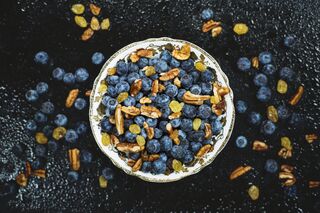
If you want to ditch the refined carbs for something better for the brain, where should you look? One great source of healthier calories and nutrients is nuts and seeds. The studied benefits of nut consumption include better blood sugar control and healthier weight. Nuts are rich in specific fats linked to better brain health. Because of this, it’s been proposed that consistent nut consumption could help offset the risk for brain diseases. Some great options include almonds, walnuts, cashews (technically a seed), and pumpkin seeds.

Berries are another great substitute for sweet and processed carbohydrates. They are rich in plant nutrients called polyphenols, which have been linked to better brain health. In addition, berries tend not to spike blood sugar as much as typical refined carbohydrate-based snacks. One amazing example is blueberries, an especially healthy brain snack that can protect brain cells from age-related damage.

3. Swap soda and energy drinks for sparkling water and unsweetened coffee

In general, we consume far more added sugar than any nutritional organization recommends. For example, the World Health Organization recommends we consume less than 5 percent of our calories from added sugar, yet in the US, that number is closer to 15 percent. Added sugar has been linked to a wide variety of negative health outcomes, including worse brain health, but the evidence here is perhaps most notable for sugary beverages. In addition to the risk for weight gain and metabolic dysfunction, some research suggests that sugary drinks are linked to an increased risk for the development of dementia and depression.

The big reasons we enjoy soda and energy drinks are pretty straightforward: we get thirsty, they taste good, and they often provide a boost of caffeine. So instead of trying a direct swap for basic water, some great alternatives include flavored sparkling waters (when looking for a tasty thirst-quencher) and turning to coffee or tea (both studied for potential benefits to brain function) when you’re looking for an energy pick-me-up.

Read More