Slider Image 1 Content

Choose best, Choose tasty
Slider Image 1 Content

Slider Image 2 Content
Here you can showcase the x number of Featured Content. You can edit this Headline, Subheadline and Feaured Content from "Appearance -> Customize -> Featured Content Options".

NEW ALBANY, Ohio (WCMH) — A new food and retail hall is opening in New Albany this month with several local food vendors, a liquor bar, a boutique and an event space.
Spanning 15,000 square feet, Bubbly Hall is opening by the new year within New Albany’s International Business Park at 6031 Central College Road. General manager Barbara Passeno said the vibrant space aims to attract locals for more than a quick trip.
“The idea behind Bubbly Hall is to bring a healthy, joyful, vibrant lifestyle to the community,” said Passeno. “We want a place where customers can come and enjoy themselves.”

A 6,800 square-foot dining space will be home to eight food vendors: Fay’s Crepes, Somali cuisine from Hoyo’s Kitchen, Just Chicken, The Pit Barbecue Grille, Lebanese cuisine from Mr. Hummus, Seoul Food On The Go, Kiku Sushi Bar and The Cheesecake Girl. Guests can also visit the liquor and wine bar for chocolate pairings from Mello Chocolate and unique drinks featuring hot sauce from Sauce Boss Gang.
In addition, the structure houses a 2,300-square-foot event space for catered meetings and celebrations, which opens to the property’s 7,000-square-foot outdoor green space.
Bubbly Hall has partnered with several home-based businesses to stock a boutique with a range of products, including body butters, wax-candle melts, jewelry, hand-crocheted shawls, men’s beard oil and gift baskets. Sunbear Studios, an art gallery in Westerville, will be installing local artist creations available for purchase. Passeno said the inventory in the space will rotate regularly.


Community members can rent out the hall’s market booths for varying times to sell their home-based products, such as jams, cookies, honey and more. A community corner will be a designated space from groups like the local girl scout troop to sell cookies at no charge.
Passeno said the community corners, boutiques and market booths are designed to aid local businesses and provide an opportunity for entrepreneurs who don’t have the means to distribute their product on a larger scale.
“Bubbly Hall will offer local entrepreneurs a place to be a brick-and-mortar store with small upfront and operational costs,” said Passeno.
An opening date is yet to be determined, said Passeno. Once open, the food and retail hall will be operating the following hours:
Follow updates from Bubbly Hall on its upcoming opening date here.
You know Lake Bell. But do you know Lake Bell…on weed???
Her kids definitely do — at least, according to some comments she gave at a panel sponsored by the cannabis drinks brand Cann (via People).
During the panel, Lake said that she “can’t get through the holidays without” cannabis — and that she’s found that it improves her parenting skills, too.
“I am straight up a better parent when I’m just two Canns in,” Lake said. “I’m, like, on their level.”
Yes, Lake’s comments sound suspiciously like sponge — like, “two Canns”? Who the hell says that unless they’re, like, at an event sponsored by Cann? But it does also sound like she really does enjoy getting stoned and being around her kids.
“I’m just like, ‘That is a fucking crazy dinosaur!'” Lake explained while taking the audience on a journey into her deeply stoned mind.
“Like, ‘Let’s get on the ground right now and be fucking crazy dinosaurs, let’s open some presents. Fuck it.’ I became literally a kid.”
I mean, sounds fun — but I’m staying out of taking a side on this one; it’s none of my business. Feel free to go off in the comments, though.
Mark and Diane Kobayashi pose with a few of the last bags of their family’s iconic Maui Kitch’n Cook’d potato chips Friday afternoon in Kahului. The familiar clear plastic bags with distinctive red-and-yellow prints are soon to be things of the past as the longtime family business closes down Dec. 15. — The Maui News / MATTHEW THAYER photo
For the past 66 years, customers have known that you can’t stop after just one of Maui Potato Chip Factory’s signature “Kitch’n Cook’d” chips.
As the family-owned and operated Kahului business closes on Dec. 15, the next generation may not get to experience this iconic salty snack, but the local company’s legacy is steadfast.
Third-generation owner, operator and potato chip maker Mark Kobayashi said the Maui Potato Chip Factory would not stay in business as long as it has without its regular customers and support from its employees, family, friends and neighbors.
“For us to have survived 66 years is more a triumph of community to take care of the local people here, the local companies,” Kobayashi said Wednesday afternoon. “A lot of times we were lucky because we were a small business and all these people who really didn’t have to step up, they stepped up and helped us out to survive and keep our name in the limelight.”
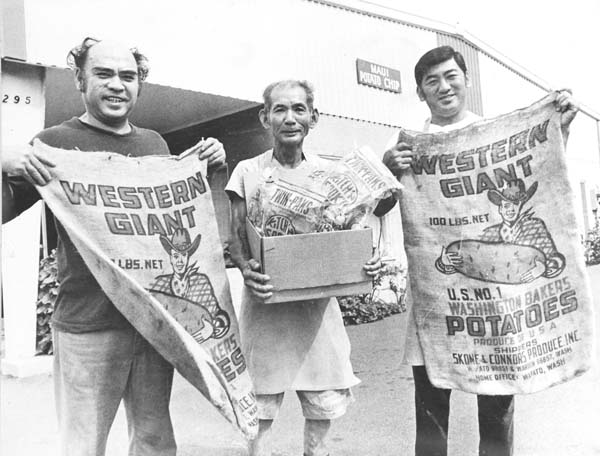
The original Maui Potato Chip Factory was established in January 1956 when Kobayashi’s late grandfather, Yoshio Kobayashi, took over the business for just $500. Yoshio was already familiar with the art of cooking potatoes, having worked at the factory, and also from his time as a chef at military camps located in “country potato,” like Montana, during World War II.
Founder Yoshio Kobayashi poses with sons Dewey Kobayashi (left) and Takayuki “Joe” Kobayashi in a family photo on display in the sales room of Maui Potato Chip Factory. — The Maui News / MATTHEW THAYER photo
He would ride with the sergeant and distribute meals to the workers in the field, Mark said.
His grandfather tweaked the recipe and produced handmade potato chips with no preservatives. As the business grew, Mark’s father, Dewey Kobayashi, and Uncle Takayuki “joes” Kobayashi stepped in to help. After school in the evenings, Mark and his brother, Edwin Kobayashi, would also assist with backstage operations, such as cleaning and bagging potatoes, in between homework assignments.
“My early memories were of my grandfather, grandmother, mother and my father, they would sit around in a circle and hand-peel bags of potatoes,” Mark said.
Then, while his parents were at work at Maui Pineapple Company, his grandparents would stay back to make the chips, bag them and wheelbarrow the goods across the street to the once-buzzing Kahului Shopping Center to sell their products to the different markets.
Their original idea was to make potato chips for when residents would go to the movie theater in the shopping complex, so that they would have salty snacks to bring in, he recalled.

Under the headline, “Business is Too Good — No More Orders Please,” Dewey Kobayashi graces the cover of Parade Magazine in 1976, which is on display in the sales room of Maui Potato Chip Factory. — The Maui News / MATTHEW THAYER photo
Edwin was eventually supposed to take over the family business, but sadly passed away at 21 years old from cancer, a shock to the family. Mark was going to drop out of the University of Hawaii at Manoa to help with operations, but friends Michael Sueda and Claro Capili Jr. stepped in for one year to allow him to finish his degree in electrical engineering.
“It just blew all of our minds when he passed away and my two friends just stepped up to the plate,” he said. “My father folks really appreciate it.”
The building is currently in its third and final location at 295 Lalo St., where it has stood for 50 years. The original building located near the old Kahului Shopping Center was destroyed by a tidal wave.
Shortly after the second move to Happy Valley, The Wall Street Journal put his dad and his Kitch’n Cook’d Potato Chips on its front page in October 1975. From that point on, the business boomed. Customers started to learn the exact day and time that potato chip deliveries would take place so that they could get in line first.
His father quickly became the face and voice of the company, Mark said.
“Basically we were just the little guy, just trying to survive,” he said. “Then, it got crazy.”
Over the years, the see-through bags with red-and-yellow labels have become a nostalgic childhood memory for the Maui community and are nationally recognized.
At the company’s peak, there were 40 employees, Mark said, but recently he’s been the sole potato chip maker using a long-standing family