Free food for all? Absolutely. In this age of abundance, it should be a human right
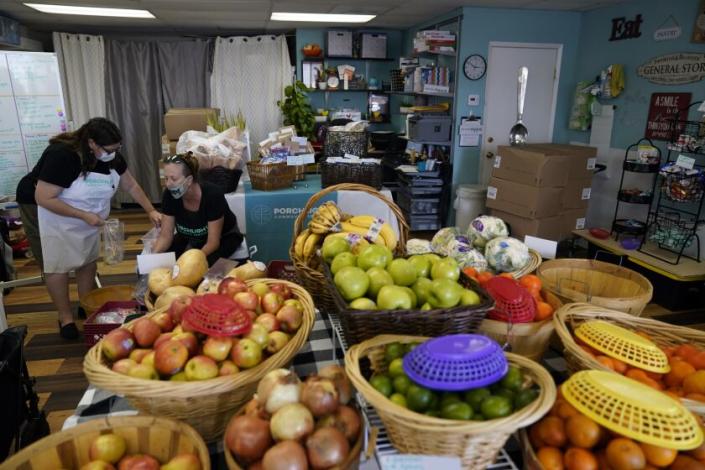
Claudia Montenegro, left, talks with Elizabeth Shoemaker at Porchlight Community Service food pantry Thursday, May 6, 2021, in San Diego.  For millions of Americans with food allergies or intolerances, the pandemic has created a particular crisis: Most food banks and government programs offer limited options.  (AP Photo/Gregory Bull)

Claudia Montenegro, left, with Elizabeth Shoemaker at Porchlight Community Service food pantry in San Diego in 2021. Nonprofits help to meet a need, but the government could do more for food security and farmers. (Gregory Bull / Associated Press)

Everyone should have access to food. Yet it’s not considered a human right — like education or healthcare or drinking water — that is defended and guaranteed by the government. why?

Maybe because, until recently, it was hard to imagine the technology, the industrial systems and the abundance to support universal food access. But it’s looking possible these days, and tentative experiments are moving the US in that direction.

The idea of ​​providing total access to food has been taking hold in different forms: As lines outside of food banks persisted and hunger skyrocketed during the pandemic, public schools temporarily offered free meals to all students. In the last two years, lawmakers have been debating bills that would make school lunches free for all, permanently.

States including California, Maine, Massachusetts, Nevada and Vermont and cities like New York have already secured funding for their own free meal programs, regardless of family income. Universal food policies have also appeared in Minnesota, Maryland, New York, North Carolina and Wisconsin. In 2021, West Virginia policymakers proposed adding a “right to food” to the state’s constitution, while Maine’s House of Representatives overwhelmingly voted for a similar measure. The United Nations food systems summit in 2021 even promoted the idea of ​​universal access globally.

One way to achieve universal access in the US would be a new public food chain. Like the parallel systems of private and public schools or hospitals, it could be funded by the state or federal government and could coexist with the current marketplace. It could repurpose some of the subsidies that have been helping consolidated agribusiness for decades, ensuring that taxpayer money instead pays for food that would be made available outside the commodity system. This idea seems particularly urgent when the markets have been co-opted by corporations and billionaire landowners.

Universal food access would give hungry families another layer of support, without any shame. Universal food, crucially, would augment federal nutrition programs like food stamps, which cost the federal government more than $100 billion a year without reshaping the food industry for the better, while also stigmatizing beneficiaries.

That’s part of the appeal to Spanish chef José Andrés, who leads an organization to provide free meals after natural disasters. Universal access is an improvement over public assistance programs. “The system that is clear right now is, everybody is going to know you are in need. Anybody can be having a hard time,” Andrés told me. “Let’s create systems that don’t shame anybody.”

One way to do that would be to restructure some food companies, distribution warehouses and retailers as a public utility, like how the energy grid, sewers and water delivery are managed. If some processing plants, distribution warehouses and retailers were owned by the government, they could use subsidies to buy grains, legumes like beans and meat directly from farmers, and the resulting goods could be made freely available to everyone. Programs could alternatively take the form of universal school meals and open-to-all cafeterias that serve meals throughout the day.

I’m rooting for a different approach that strikes me as easier to implement, because it can operate within the existing food industry.

Errol Schweizer, formerly Whole Foods vice president of grocery, started researching the idea of ​​a “public food sector” after the 2021 blackout in Texas when a winter snowstorm devastated the state’s power grid. Without heat and water in most places, 246 people died. In Austin, Schweizer and his family were without water for a week. He wondered: Why doesn’t the city have its own emergency response department that could operate as a publicly owned food distribution system to make sure residents are fed in times of crisis?

“I came at this from being a retailer,” Schweizer told me. “It still needs to be framed around meeting demand. Supply chains don’t come into existence naturally. They respond to the power of purchase orders.” An emergency system like he envisioned could be the beginning of reshaping the food supply chain, because the government could become a major purchaser and could exert influence.

That’s how markets are built to work, not through subsidies such as those in the five-year, $400-billion farm bill that was enacted in 2018. Debate about its successor will begin in the months ahead, to be passed by the new Congress next year. That’s an opportunity to shift funding away from subsidies and toward market-based solutions.

With a public food sector, farmers would directly benefit, without giving part of their share away. Markets would also add another buyer, fixing how uncompetitive some meat markets in

Read More

Satay and sambal: 12 foods every Indonesian visitor needs to try

Editor’s Note — This CNN Travel series is, or was, sponsored by the country it highlights. CNN retains full editorial control over subject matter, reporting and frequency of the articles and videos within the sponsorship, in compliance with our policy.

(CNN) — As the world’s largest archipelagic nation, Indonesia is filled with different cultures and influences spread out over 1,904,569 square kilometers (735,358 square miles).

This makes it a huge challenge to try to summarize the flavors of the country in just a few paragraphs.

“Indonesian food culture is based on regional cooking among 17,500 islands, 38 provinces and 700 dialects,” says Indonesian cookbook author William Wongso.

“Flavors of Indonesia are very diverse. From Aceh (the westernmost province of Indonesia) to West Sumatra (also a western province), it’s only about a 1.5-hour flight, yet their food and taste profiles are totally different.”

The 75-year-old author of “Flavors of Indonesia: William Wongso’s Culinary Wonders.” says that even though he’s been traveling and eating around Indonesia for decades, he still hasn’t tasted every local dish.

For example, chefs in the Moluccas on the eastern side of Indonesia, once nicknamed the “Spice Islands,” prefer using fresh spices like cloves, nutmeg and cinnamon. Aceh, on the other hand, frequently incorporates dried spices thanks to the influence of India, Arabia and China.

Padang (or Minangkabau) cuisine in West Sumatra uses lots of coconut cream, chiles, shallots and some curry spices, as well as ginger and galangal with aromatic herbs such as turmeric leaves, kaffir lime leaves and lemon grass.

Javanese are experts in using the three colored spice pastes — red (made of chiles, shallots and garlic), white (candle nuts, shallots and garlic) and yellow (candlenuts, shallots, garlic and turmeric).

“The taste profile of Central Java is sweeter than Eastern Java,” added Wongso.

Ready to enjoy the overwhelming diversity of Indonesian cuisine? Here are a few dishes that offer a sample of the many delicious flavors on offer.

Rendang beef

Beef rendang is unbelievably tender.  The beef is coated with dry curry that has been stewed for hours.

Beef rendang is unbelievably tender. The beef is coated with dry curry that has been stewed for hours.

asab974/Adobe Stock

It isn’t an exaggeration to say that beef rendang is one of the world’s most flavorful foods.

A dry curry dish linked to the Minangkabau ethnic group, which is indigenous to West Sumatra, rendang is a great way to preserve meat — essential for the Minangkabau people during their travels.

There is no one recipe for rendang. “In West Sumatra, there are about 900 districts and each has their own style of rendang,” says Wongso.

But one of the most common meats that appear in rendang is beef. It’s stewed in coconut milk and spices including lemongrass, galangal, garlic, turmeric, ginger and chiles for hours until the meat is unbelievably tender and the curry mixture is reduced to a relatively dry coating around the meat.

Tempeh

A rising star in plant-based diets around the world, tempeh has in fact been a constant in Javanese culture for more than four centuries.

The low-fat, high-protein meat substitute is made of soybeans fermented in banana leaves — and sometimes, other leaves — for two to three days before it turns into a white, moldy and chunky block.

Its flavor is often described as nutty and mushroom-y with a slight sweet soy scent.

It can be cooked the same way as any meat — baked, fried, grilled or boiled into different dishes. In Indonesia, it’s often deep-fried and served as a tasty snack.

Satay

A staple at Southeast Asian restaurants around the world, satay — or satay in the local tongue — is said to have originated in Java.

The preparation of these skewers varies from region to region, often featuring different meats or vegetables, spices, sauces and marinades.

One of the most loved versions in Indonesia is chicken satay served with a sweet peanut sauce that has just a hint of spice.

Fried rice

Fried rice: So much more than just fried rice.

Fried rice: So much more than just fried rice.

Jairson/Adobe Stock

If there’s one staple that represents Indonesia’s multi-faceted culture, it’s fried rice — literally translated as fried rice.

Each household has a different recipe made with various ingredients and sides, but the use of terasi (shrimp paste) and kecap manis (a sweet and thick Indonesian soy sauce) unite most — if not all — versions.

These condiments create Indonesian fried rice’s unique taste.

Topped with a perfect sunny-side-up egg and a side of crunchy shrimp crackers (or kerupuk), nasi goreng is a versatile meal eaten throughout the day.

A dish influenced by Chinese cooking, fried rice is as popular in Singapore and Malaysia as it is in Indonesia.

Shrimp crisp

While prawn crackers are commonly found in several countries’ diets — especially in Indonesia and Malaysia — it was thanks to Indonesia that the snack was introduced to the Dutch and then brought

Read More

Eating off certain colored plates improves the taste of food for picky eaters

Researchers at the University of Portsmouth have found picky eaters perceive food eaten out of red bowls to be saltier and less desirable than the same food served in white bowls. The findings add to understandings of how taste perception can be influenced by plates and cutlery.

We all may know someone we consider to be a picky eater, prone to disliking some common ingredients and causing social havoc when ordering at restaurants. But for some people picky eating can actually become a serious disorder, and clinical definitions of picky eating behaviors often include people who only consume around 20 different kinds of foods.

“Having restricted diets can lead to nutritional deficiencies as well as health problems such as heart disease, poor bone health and dental issues,” explained Lorenzo Stafford, one of the authors on the latest study. “There is also a social cost because normally enjoyable moments between family members can easily turn into stressful, anxious, and conflict-causing situations when picky eaters feel ashamed or pressured to eat food.”

A 2018 study estimated nearly one in five American adults could be clinically categorized as picky eaters. So exploring ways to help these people better engage with more types of food could result in valuable health outcomes.

The new research homed in on the effect of plate color on food desirability for picky eaters. The experiment was based on a foundational study from 2011 which looked at the way different colored food bowls affected a person’s perception of taste.

Using a design similar to the 2011 research, the new experiments had participants rate the sweetness, saltiness and overall desirability of a snack food eaten from different-colored bowls. In this example the snack was salt and vinegar potato crisps consumed from either a red, blue or white bowl. Around 50 participants were recruited, classified as either picky or non-picky eaters based on a standard questionnaire.

The results revealed picky eaters perceived the snack to be saltier when it was eaten from a red or blue bowl compared to the white bowl. And overall, picky eaters found the snack generally less desirable when eaten from a red bowl.

Interestingly, the study found the effects of bowl color on food taste and desirability were only apparent in the picky eater group. The non-picky eaters were relatively uninfluenced by bowl color.

This finding suggests the influence of plate colors on food taste may be most relevant for picky eaters. This result does track with other studies suggesting the influence of plate shape and color on food is, “anything but straightforward.”

A 2013 study that looked at black or white and square or round plates found white round plates tended to enhance “basic judgments” around food, such as sweetness or taste intensity. However, more complex judgments, such as perceptions of quality or liking, could be enhanced by black square plates.

According to Stafford, the findings from this latest study could be useful in helping picky eaters learn to accept a wider variety of foods.

“This knowledge could be useful for those trying to expand their repertoire of foods,” said Stafford. “For example, if you wanted to encourage a picky eater to try more vegetables that are known to be viewed as bitter, you could try to serve them on a plate or bowl that is known to increase sweetness.”

The new study was published in the journal Food Quality and Preference.

Source: University of Portsmouth

appId : '38456013908',

xfbml : true, version : 'v3.3' }); };

(function(d, s, id){ var js, fjs = d.getElementsByTagName(s)[0]; if (d.getElementById(id)) {return;} js = d.createElement(s); js.id = id; js.src = "https://connect.facebook.net/en_US/sdk.js"; fjs.parentNode.insertBefore(js, fjs); }(document, 'script', 'facebook-jssdk')); … Read More