Slider Image 1 Content

Choose best, Choose tasty
Slider Image 1 Content

Slider Image 2 Content
Here you can showcase the x number of Featured Content. You can edit this Headline, Subheadline and Feaured Content from "Appearance -> Customize -> Featured Content Options".

Reiko Yokota, Pastry Chef of Four Seasons Hotel Kyoto
Born in Hokkaido, raised in America, and trained at some of France’s most lauded establishments like Le Clown Bar and Pierre Sang in Oberkampf, Reiko Yokota draws upon her worldly upbringing as the Pastry Chef of Four Seasons Hotel Kyoto.
“Traveling and all of these experiences gave me a unique perspective when it comes to desserts,” says Yokota, who’s quickly established herself as a culinary star to watch with her intellectual and artistic approach in the kitchen. She continued, “I love the transformation process of my work. I can shape the ingredients into whatever I want, it’s almost like a game for me.”
Fall Afternoon Tea at Four Seasons Hotel Kyoto
While Yokota’s job is sweet-centric, she frequently thinks about how to reimagine traditional savory dishes and flavors. This mindset is especially evident in the hotel’s very popular afternoon tea. On the current fall menu, for example, a creamy mushroom soup becomes lighter and is as tasty as a mushroom cappuccino, while a tea sandwich takes on local influences with grilled eggplant and smoky eel. “Because Japan has four true seasons, all of our ingredients have a distinct, but delicate flavor,” Yokota explained. “This is what I want people to experience and taste, while staying true to nature and keeping the vibrancy of the original product.”
Outside of work, Kyoto is just as passionate about exploring Kyoto’s ever-evolving dining scene. Here, she shares her favorite restaurants in town—all of which are small and independently owned.
LURRA°
“Jacob, the chef, worked at Copenhagen’s Noma, and brings a simliar cooking style to LURRA° with an innovative chef’s tasting menu. He uses a wood-burning oven, and no gas. The food is very creative and reflects the seasons. Jacob himself goes out to the fields and forages many ingredients. The restaurant has one Michelin star, and offers two seats for dinner.”
Mon
“This Japanese restaurant specializing in Kaiseki cuisine also has one Michelin star. It’s a very small place, and not very well known. The way they prepare fish is unbelievably good—it almost tastes magical. The beauty of dining here is not just about the seasonal ingredients, but the actual plates themselves. Many of them have historical value, so you can see the beauty of Japanese culture while you eat.”
To.
“With only about 10 counter seats, the style of To. is best described as Italian with Japanese and Moroccan influences. Because it offers tapas-style small plates, you can try a lot of different things. Everything tastes so fresh and exciting. There’s a sake counter as well.”
Sushi Ovino
“This is another very small restaurant where reservations are needed. What’s unique about this place is that the chef has a very strong sense of smell. He understands that good taste, especially when it comes to something as delicate as sushi, has to be well-balanced between aroma, texture and taste.”
Sabi
“While this spot pairs Japanese tea with different seasonal sweets, it’s not completely traditional. The owner performs the actual tea ceremony, and has modernized it with a thoughtful design and unique ingredients. The experience is so interesting, as you sit in a very quiet room for about two hours.”
In Kyoto, Tori Paitan is the popular style of ramen. The broth is typically made from chicken bones and feet, and is slow-cooked for so long the color becomes milky-white. The flavor is very intense, yet delicate. It’s not too strong or salty.”
Researchers at the University of Portsmouth have found picky eaters perceive food eaten out of red bowls to be saltier and less desirable than the same food served in white bowls. The findings add to understandings of how taste perception can be influenced by plates and cutlery.
We all may know someone we consider to be a picky eater, prone to disliking some common ingredients and causing social havoc when ordering at restaurants. But for some people picky eating can actually become a serious disorder, and clinical definitions of picky eating behaviors often include people who only consume around 20 different kinds of foods.
“Having restricted diets can lead to nutritional deficiencies as well as health problems such as heart disease, poor bone health and dental issues,” explained Lorenzo Stafford, one of the authors on the latest study. “There is also a social cost because normally enjoyable moments between family members can easily turn into stressful, anxious, and conflict-causing situations when picky eaters feel ashamed or pressured to eat food.”
A 2018 study estimated nearly one in five American adults could be clinically categorized as picky eaters. So exploring ways to help these people better engage with more types of food could result in valuable health outcomes.
The new research homed in on the effect of plate color on food desirability for picky eaters. The experiment was based on a foundational study from 2011 which looked at the way different colored food bowls affected a person’s perception of taste.
Using a design similar to the 2011 research, the new experiments had participants rate the sweetness, saltiness and overall desirability of a snack food eaten from different-colored bowls. In this example the snack was salt and vinegar potato crisps consumed from either a red, blue or white bowl. Around 50 participants were recruited, classified as either picky or non-picky eaters based on a standard questionnaire.
The results revealed picky eaters perceived the snack to be saltier when it was eaten from a red or blue bowl compared to the white bowl. And overall, picky eaters found the snack generally less desirable when eaten from a red bowl.
Interestingly, the study found the effects of bowl color on food taste and desirability were only apparent in the picky eater group. The non-picky eaters were relatively uninfluenced by bowl color.
This finding suggests the influence of plate colors on food taste may be most relevant for picky eaters. This result does track with other studies suggesting the influence of plate shape and color on food is, “anything but straightforward.”
A 2013 study that looked at black or white and square or round plates found white round plates tended to enhance “basic judgments” around food, such as sweetness or taste intensity. However, more complex judgments, such as perceptions of quality or liking, could be enhanced by black square plates.
According to Stafford, the findings from this latest study could be useful in helping picky eaters learn to accept a wider variety of foods.
“This knowledge could be useful for those trying to expand their repertoire of foods,” said Stafford. “For example, if you wanted to encourage a picky eater to try more vegetables that are known to be viewed as bitter, you could try to serve them on a plate or bowl that is known to increase sweetness.”
The new study was published in the journal Food Quality and Preference.
Source: University of Portsmouth
appId : '38456013908',
xfbml : true, version : 'v3.3' }); };
(function(d, s, id){ var js, fjs = d.getElementsByTagName(s)[0]; if (d.getElementById(id)) {return;} js = d.createElement(s); js.id = id; js.src = "https://connect.facebook.net/en_US/sdk.js"; fjs.parentNode.insertBefore(js, fjs); }(document, 'script', 'facebook-jssdk')); … Read More
Restaurants in River North cut their operating hours more during the COVID-19 pandemic than restaurants in any other part of the country, according to a new survey.
Some restaurants have stopped serving lunch altogether. Some restaurants are now closed several days a week to remain profitable.
On average, River North restaurants in the 60654 ZIP code cut 20.2 hours per week between October 2019 and October 2022, according to an analysis by Datassential, a Chicago-based firm.
That figure massively outpaces the national average drop of 6.4 hours per week over the same period, the analysis shows.
In terms of operating hours cut, New York City has 12 of the top 15 ZIP codes — but the River North was higher than any of them, taking the top spot.
But why were River North restaurants the most vulnerable?
Restaurant owners point to several factors: inflation, a persistent lack of workers, changing consumer habits. But the biggest issue may be workers’ sluggish return to downtown.
“River North got hit the hardest because it was so close to the financial district — but it never really brought people back to work,” said Sam Sanchez, CEO of Third Coast Hospitality.
Sanchez hasn’t held lunch service at his two River North restaurants, Tree House Chicago and Moe’s Cantina, since COVID hit.

Moe’s Cantina, 155 W. Kinzie St.
Sanchez said he’d go out of business if he didn’t cut those lunch hours, since labor made up so much of his operating costs. And he hasn’t seen the crowds return for happy hour either.
“I’m not going to open for lunch if I only have 10, 20, 30 tables throughout the lunch period,” he said. “And people don’t go out late at night on Monday, Tuesday, Wednesday. So you don’t open” then.
Restaurants are also closing earlier nationally. On a typical Wednesday evening, about 41% of restaurants are open at 9:45 pm, compared to 56% in 2019, the survey found.
Sanchez hopes more people return to work in the spring.
“We need a density of people. We need traffic. We need new ideas. We need to draw people to River North,” he said.
Workers have remained stubbornly absent from the central business district since COVID hit nearly three years ago.
The office occupancy rate is still less than half of what it was in 2019, and pedestrian traffic is two-thirds what it was then, according to an analysis by the Chicago Loop Alliance. Developers seeking to adapt to the new normal have proposed turning empty office space into apartments to revive the once-bustling La Salle Street corridor.
One positive sign: Business events and conventions have begun returning to Chicago, Sanchez said.
But he’s preparing for a rough winter. In January and February, he’ll probably keep his River North restaurants open only three days a week.
Aside from a lack of customers, restaurants have been reeling from a shortage of workers.
“A lot of owner/operators are saying to me, ‘We really need more team members,’” said Sam Toia, president of the Illinois Restaurant Association. “When you’re lacking team members, you’ve got to cut your hours.”
Across the country, two out of three restaurants were understaffed in August, according to the National Restaurant Association.
Kevin Vaughan owns the Emerald Loop, 216 N. Wabash Ave., and the Chicago Brewhouse on the Riverwalk. He, like others, has struggled to attract workers.
“It’s a tough business to be in right now. We work nights and weekends. It’s a tough, customer-facing job,” he said.
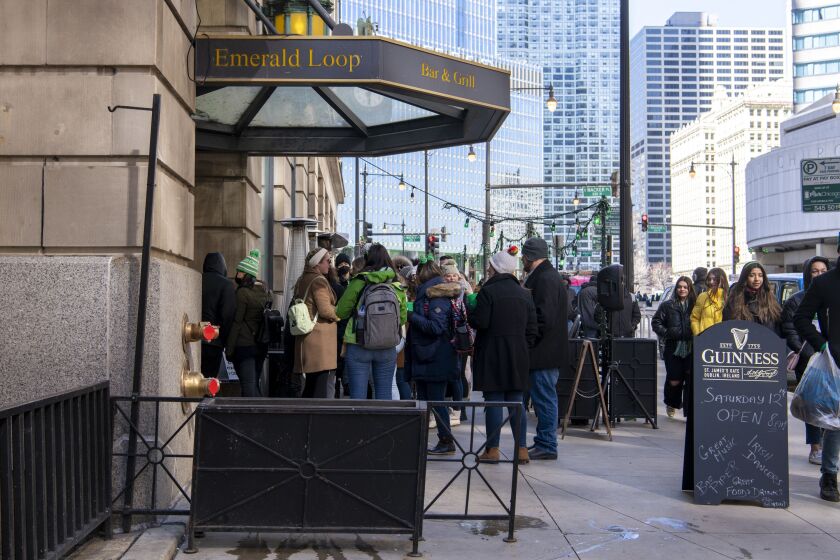
Dozens of people line up outside the Emerald Loop Bar and Grill, after the St. Patrick’s Day Parade in downtown Chicago in March.
Tyler Pasciak LaRiviere/Sun-Times
Many of those potential workers are opting to work in the gig economy, he said.
“We offer a lot of flexibility, but the gig economy offers even more flexibility,” said Vaughan.
He’s reached out to community colleges to attract workers so he won’t have to cut hours. “About 50% reply to interview requests. And when we schedule interviews, we’re batting about 50% after that,” Vaughan said.
The Illinois Restaurant Association has tried to address the worker shortage by advocating for immigration reform. Declining immigration under the last two presidential administrations may be behind the lack of available workers, Toia said.
He wants working visas for hospitality workers, just as the US does for farm workers. That idea could gain bipartisan support because this staffing problem hits red and blue states alike, he said.
Restaurants have also cut their hours to accommodate changing consumer habits. Customers are ordering takeout more and preferring to eat at home, either as a way to save cash or remain COVID-safe.
Takeout and delivery rates have nearly doubled since before the pandemic, and that has cut into restaurants’ revenue, Toia said.
Ordering takeout and delivery “was starting to become