Fredericksburg restaurant raided by Virginia ABC for illegally serving alcohol

A Fredericksburg restaurant owner and political candidate says he’s not done fighting, just days after his business was raided by the Virginia Alcoholic Beverage Control Authority.

“What the state of Virginia just did is they took my livelihood away from me right before Christmas,” Gourmeltz owner Matt Strickland told FOX 5 Monday.

Strickland has been in the headlines before.

Early in the pandemic, he refused to follow Virginia’s COVID-19 guidelines, like encouraging mask-wearing and social distancing.

Ultimately, both the restaurant’s health and alcohol permits would be suspended.

PREVIOUS COVERAGE: Restaurant owner says he’s staying open after license suspended for COVID-19 violations

Strickland went to court and got his health permit back, but the Virginia ABC wrote that despite a lengthy legal battle and the Circuit Court of Spotsylvania County ruling in the ABC’s favor, Gourmeltz “… continued to serve beer, wine, and mixed beverages to customers.”

“I knew that the only way we’d come out of this was by the community standing together and fighting back against this tyrannical government, so I continued to sell alcohol,” Strickland said.
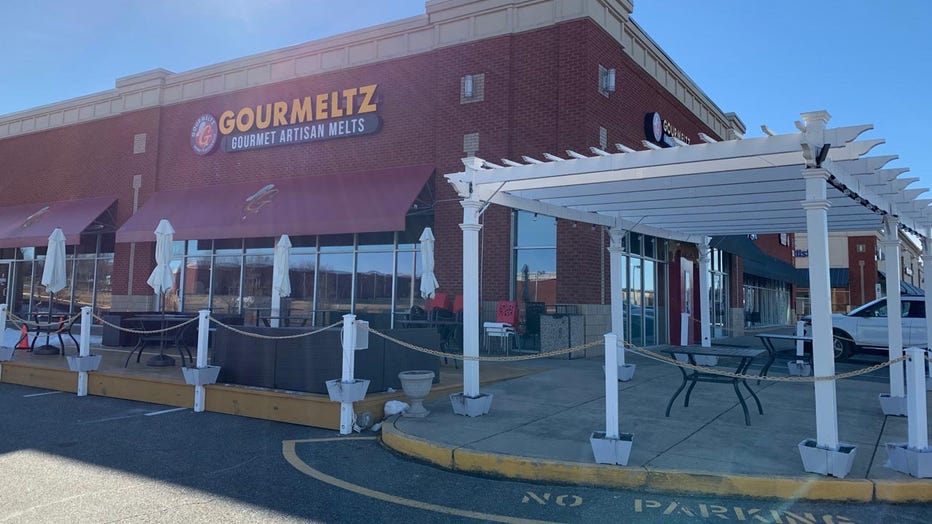
The ABC also said they’d reduce the alcohol license suspension to 15 days upon the payment of a $4,000 penalty and another $6,469.18 to cover the investigation.

Judge says defiant Fredericksburg restaurant that broke COVID-19 rules can stay open, according to attorney

“I’m not paying any fine. I’m not serving any suspension, and the reason for that is because I did nothing wrong,” Strickland said.

Instead, the Army veteran has vowed to continue his fight, now planning to run for the State Senate in 2023.

“I’m not concerned whatsoever,” Strickland said when asked if he was worried the state could take further action against his business. “I’ve been ready to die for my country since I was 17 years old, and I’m willing to fight as long and as hard as it takes to make sure that this fight that I’m in right now, this fight that we’re all in right now, doesn’t get passed down to the next generation.”

The Virginia ABC developed a timeline of administrative proceedings and actions related to Gourmeltz, but declined further comment.
Read More

Inflation drives more Wisconsin college students to food pantries

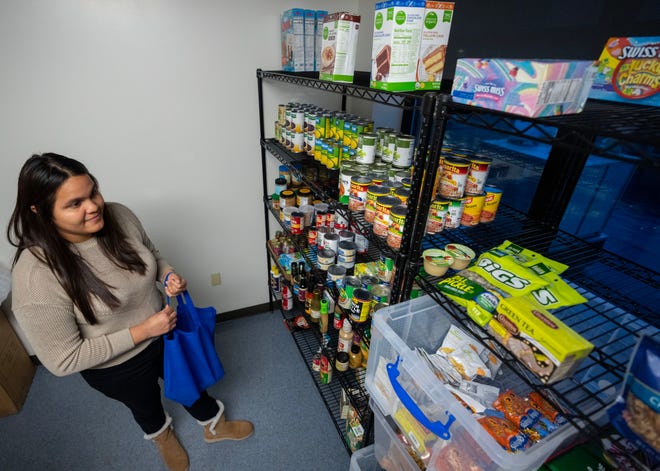
Student Pamela Delgado selects items from a food pantry at MATC's Walker Square campus, 816 W. National Ave., in Milwaukee The pantry opened Tuesday.

A ribbon-cutting event for a former storage room marked a milestone for Milwaukee Area Technical College.

MATC converted the small space at its Walker’s Square campus into a food pantry that opened Tuesday. It’s the last of MATC’s five campuses to open a food pantry for students, all of which were launched within the last year.

The pantries couldn’t have come at a better time.

Soaring food costs have college students feeling the pinch. The need is especially great at Walker’s Square, which is on the near south side in the heart of Milwaukee’s Latino community. Many students at the campus are enrolled in the GED or English as a Second Language programs while working minimum wage jobs that don’t provide enough to cover rent, gas, groceries and other expenses.

Equan Burrows, MATC’s dean of student experience, said the college had previous iterations of food pantries, such as donated canned goods stocked in the corner of a room or breakfast bars slipped to hungry students.

But he said MATC’s partnership with Feeding America is more formalized and ensures the school’s long-term commitment to addressing food insecurity, a relatively widespread problem plaguing community colleges in which students don’t have the resources to feed themselves nutritiously, or even at all.

“This is groundbreaking,” Burrows said about the opening of pantries at every MATC campus. “And this is something we can sustain.”

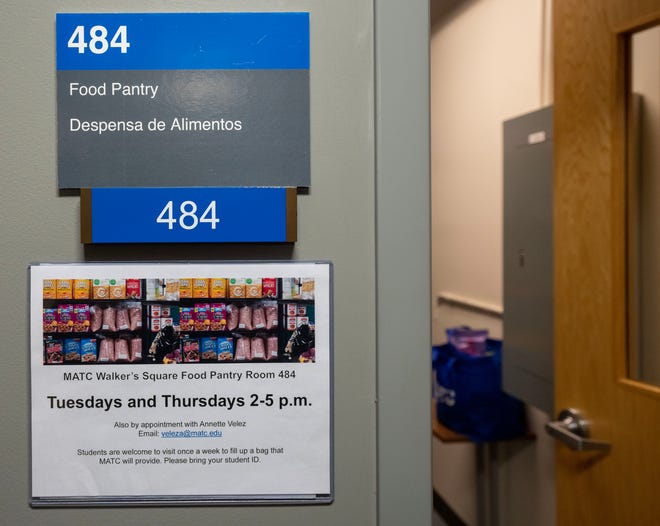
The entrance to a food pantry is shown Tuesday at MATC's Walker Square campus.  Food pantries are located on each MATC campus.

The need for the food pantries at MATC is ‘higher than anticipated’

A survey conducted by Temple University’s Hope Center for College, Community and Justice illustrates the immense need for food pantries at MATC. Half of the school’s nearly 2,700 survey respondents reported experiencing food insecurity in the previous 30 days. That’s higher than the 39% of two-year students facing food issues nationally.

MATC opened the first food pantry at its downtown campus in November 2021. What started as a 500-pound weekly food order has grown to a 1,400 pound order — and that’s without accounting for the addition of the Walker’s Square campus.

At the downtown campus pantry alone, more than 1,200 visits have happened so far this semester, said Haley Weber, whose job as MATC’s coordinator of student services is to remove barriers students face to earning their degrees. In addition to non-perishable items for pickup, the main campus also offers about 200 hot meals per week made by culinary programs students using leftover food that would otherwise have gone to waste.

“The need has been even higher than anticipated,” she said. “Some students come every single day for lunch.”

The cost to the college is minimal, maybe $600 a month, Weber said. If Feeding America has a week in which donations are low, MATC buys food from the nonprofit at a reduced price.

The benefits of campus pantries are vast. Food insecurity is fundamentally a retention issue. Students without enough to eat are unlikely to be able to stay in school.

Among MATC’s pantry shoppers was Ivonne Ruiz, a full-time student in the English as a Second Language program. With food prices so high, she said she limits what she buys to the bare essentials. The campus pantry helps supplement her groceries.

Another shopper who visited a MATC pantry at least once a week was a mom who said she didn’t receive enough food stamps to feed herself and her three children.

Colleges and universities across Wisconsin seeing similar trends

Colleges across Wisconsin are hearing similar stories at their pantries: more visits and more students, which all of the schools attributed primarily to higher grocery prices.

At Madison Area Technical College, 464 student visits took place in the first three months of the fall 2021 semester, said student health educator Denise Holin. The same time period this fall brought 613 visits.

More than 1,000 Waukesha County Technical College students picked up bags from the school food pantry in 2019, said Stephanie McWilliams, the assistant director of student life. Since August, the school opened a second pantry location and has already handed out nearly 600 bags.

While food insecurity hits Black, first-generation and two-year college students are the hardest, four-year schools are also seeing stronger demand.

At the University of Wisconsin-Milwaukee, basic needs coordinator Allie Dorshorst said the spring 2022 semester brought about 100 students to the pantry per week. This fall, UWM is seeing an average of 230 students weekly. Inflation was a factor in the uptick, though she also said the school expanded its hours.

UW-Green Bay recorded roughly 150 visits per month before the pandemic, said Stacie Christian, the assistant vice chancellor of inclusive excellence. That increased to about 250 visits last spring and the pantry this fall is approaching an average of 400 monthly visits.

Contact Kelly Meyerhofer at [email protected]. Follow her on Twitter at @KellyMeyerhofer.

Read More

Pepsi with milk and cookies? The company wants a new twist on Santa’s treat

Pilk and cookies.

There’s nothing like celebrating the holiday season by leaving Santa Claus with his favorite snack: milk and cookies – with soda.

Pepsi unveiled its latest campaign Thursday, encouraging those who enjoy milk and cookies to add “a surprising and naughty new twist” to it by adding Pepsi to the milk, turning it into Pilk and Cookies.

Todd Kaplan, Pepsi’s chief marketing officer, in a statement insisted the combination has “long been a secret hack among Pepsi fans.”

To help launch the promotion, Pepsi got the help of Lindsay Lohan, who recently starred in Netflix’s “Falling for Christmas” and has been associated with Christmas since her “Jingle Bell Rock” performance in the 2004 film “Mean Girls.”

If you’re hesitant to try the drink yourself, Pepsi offers some recipes for people to try, like “The Naughty & Ice,” which involves mixing whole milk, heavy cream and vanilla creamer into a cup of Pepsi and enjoying it with a chocolate cookie chips. Another recipe, “The Cherry on Top,” uses 2% milk, heavy cream and caramel creamer into a cup of Pepsi Wild Cherry, pairing it with a gingerbread cookie.

Lohan said in a statement she was at first skeptical of the combinations, but she was “amazed at how delicious it was.”

Pepsi is also issuing a #PilkandCookies challenge by having people follow the company on Instagram, Twitter or TikTok and share a video or photo of their Pilk and Cookies creations along with the hashtag. Pepsi will select 25 winners who will win cash. The challenge is open through Dec. 25.

Free McDonald’s for life? Here’s how to get your hands on the rare McGold Card

What’s everyone talking about? Sign up for our trending newsletter to get the latest news of the day

Lindsay Lohan has partnered with Pepsi to promote Pilk and cookies.

What is ‘dirty soda’?

Pilk and Cookies comes as the drink idea known as “dirty soda” – mixing soda with ingredients like cream, half and half and puree – has become an increasingly popular trend.

“Now with the rise of the ‘dirty soda’ trend on TikTok and throughout the country, we thought Pilk and Cookies would be a great way to unapologetically celebrate the holidays with a new and delicious way to enjoy Pepsi this season,” Kaplan said.

The origins of “dirty soda” are unknown, but the trend began to pick up in 2010 when Swig, dubbed the “home of ‘dirty’ soda,” opened up in St. George, Utah. The soda business grew in popularity in a predominantly Mormon area, according to the New York Times, as the church prohibits hot caffeinated drinks such as tea and coffee.

The drink gained nationwide popularity in December 2021 when singer Olivia Rodrigo posted a picture of herself holding a Swig cup on Instagram. Eater reported in April there were over 700,000 mentions of #dirtysoda on TikTok following Rodrigo’s post.

Follow Jordan Mendoza on Twitter: @jordan_mendoza5.

Read More