Rabbi serves kosher food to Jewish travelers at the World Cup

Rabbi Eli Chitrik’s phone buzzes. A woman is about to show up at his Doha hotel to pick up her lunch: two bagel sandwiches.

It’s one of the many calls and messages Chitrik is receiving these days for bagel sandwiches, freshly made in a designated kosher kitchen set up for Jewish World Cup fans who want to comply with Judaism’s set of dietary regulations during the tournament in Qatar.

Chitrik said the kosher kitchen has been making 100 sandwiches a day to feed fans from around the world, including Argentina, Australia, Brazil, the United States, Uruguay and Israel. Recently, production has increased to more than 100 to meet demand.

On Fridays, the kitchen makes challah, special bread, usually braided, which is traditional food on the Sabbath.

“There were some people telling me that they would only be able to come because of this,” he said. “Some people (were) telling me that they thought this was going to be their first Shabbat without challah and now they could send the picture to their mother that they have challah.”

Rabbi Eli Chitrik

Rabbi Eli Chitrik’s bagel business has helped Jewish travelers keep kosher at the World Cup.


Rabbi Eli Chitrik

Many Jews say that Rabbi Eli Chitrik’s business is the only reason they were able to attend the World Cup.


Rabbi Eli Chitrik

Rabbi Eli Chitrik is proud that he’s able to provide Challah for Jews observing Shabbas in Qatar.


Rabbi Eli Chitrik

Rabbi Eli Chitrik says he knows everything that goes on in his kitchen so he can guarantee his sandwiches are 100 percent kosher.


Rabbi Marc Schneier, president of the New York-based Foundation for Ethnic Understanding, said he had been involved in discussions with Qatari officials for the past five years to help accommodate the attendance of Jewish fans at the tournament. Besides making kosher food available, he said, discussions included the attendance of Israelis at the World Cup and direct flights from Tel Aviv to Doha, despite Israel and Qatar having no diplomatic relations.

“It’s a very important step from an interreligious point of view … from a Qatar-Israel point of view,” he said. “There are so many levels here.”

Qatari officials, with their history of public support for Palestinians, have insisted on the temporary opening to Israelis was purely to comply with FIFA hosting requirements — not a step to normalizing ties as Bahrain and the United Arab Emirates did in 2020. Qatar, which often serves as a mediator between Israel and the Hamas militant group in Gaza, has warned that a spike in violence in the occupied West Bank or Gaza Strip would derail the arrangement. Despite a surge in deadly fighting in the West Bank in recent days, however, it has taken no action.

Having ties with Israel is a contentious topic, unpopular among many Arabs, due to factors such as Israel’s 55-year West Bank occupation and a lack of a resolution to the Palestinian issue. Israeli social media has been filled with videos showing Israeli TV reporters receiving hostile receptions from Arab soccer fans in Qatar.

The Qatari World Cup organizing committee did not respond to emailed questions about the kosher kitchen.

Early each morning, Chitrik heads to the kitchen. There, he supervises the sandwich-making process — from opening the ovens himself to inspecting ingredients for compliance with kosher standards. Sundried tomatoes in jars, for example, were excluded for containing non-kosher ingredients; tomatoes are dried in the kitchen’s oven instead.

“I know every little thing that happens in that kitchen, so that way I can tell you 100%, no question, this is a kosher sandwich,” he says.

Visitors typically make arrangements to pick up their kosher food from Chitrik. He keeps the bagel sandwiches stored in special cases in his hotel room, with labels declaring the food kosher.

Tirtsa Giller, who is visiting from Israel for World Cup-related work, came to the hotel on Sunday to pick up her lunch.

Flying into Doha, she had stuffed her luggage with dishes, a frying pan, cutlery, tuna cans and snacks to keep kosher. Working long hours and not wanting to rely on just snacks, she said she was excited when friends in Dubai told her about the new kosher offerings in Doha.

“Everyone was searching for this information, if there is kosher food,” she said. “We were afraid that it’s banned because there were rumors. I’m happy to find out it’s not.”

When he’s not in the kitchen or handing out sandwiches at his hotel, Chitrik, who was born in Israel but raised in Turkey, said he had been going out on the streets of Doha in his religious garb, including a black hat and tzitzit, a fringed garments ritual.

“I want to show that anywhere you are in the world, you can live openly as a Jew the same way, hopefully, you can live
Read More

Free food for all? Absolutely. In this age of abundance, it should be a human right

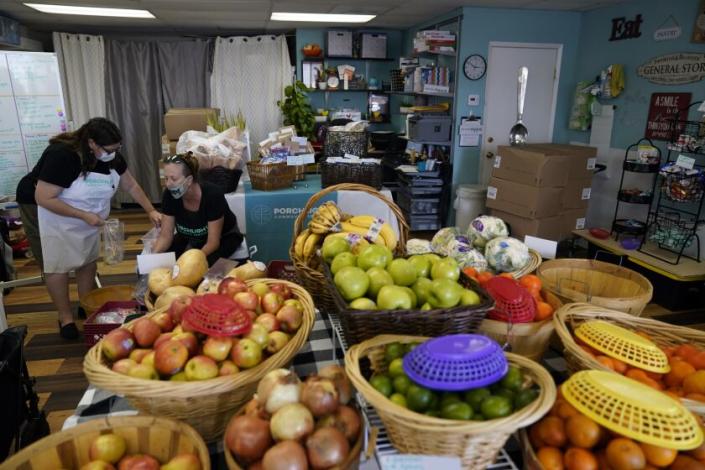
Claudia Montenegro, left, talks with Elizabeth Shoemaker at Porchlight Community Service food pantry Thursday, May 6, 2021, in San Diego.  For millions of Americans with food allergies or intolerances, the pandemic has created a particular crisis: Most food banks and government programs offer limited options.  (AP Photo/Gregory Bull)

Claudia Montenegro, left, with Elizabeth Shoemaker at Porchlight Community Service food pantry in San Diego in 2021. Nonprofits help to meet a need, but the government could do more for food security and farmers. (Gregory Bull / Associated Press)

Everyone should have access to food. Yet it’s not considered a human right — like education or healthcare or drinking water — that is defended and guaranteed by the government. why?

Maybe because, until recently, it was hard to imagine the technology, the industrial systems and the abundance to support universal food access. But it’s looking possible these days, and tentative experiments are moving the US in that direction.

The idea of ​​providing total access to food has been taking hold in different forms: As lines outside of food banks persisted and hunger skyrocketed during the pandemic, public schools temporarily offered free meals to all students. In the last two years, lawmakers have been debating bills that would make school lunches free for all, permanently.

States including California, Maine, Massachusetts, Nevada and Vermont and cities like New York have already secured funding for their own free meal programs, regardless of family income. Universal food policies have also appeared in Minnesota, Maryland, New York, North Carolina and Wisconsin. In 2021, West Virginia policymakers proposed adding a “right to food” to the state’s constitution, while Maine’s House of Representatives overwhelmingly voted for a similar measure. The United Nations food systems summit in 2021 even promoted the idea of ​​universal access globally.

One way to achieve universal access in the US would be a new public food chain. Like the parallel systems of private and public schools or hospitals, it could be funded by the state or federal government and could coexist with the current marketplace. It could repurpose some of the subsidies that have been helping consolidated agribusiness for decades, ensuring that taxpayer money instead pays for food that would be made available outside the commodity system. This idea seems particularly urgent when the markets have been co-opted by corporations and billionaire landowners.

Universal food access would give hungry families another layer of support, without any shame. Universal food, crucially, would augment federal nutrition programs like food stamps, which cost the federal government more than $100 billion a year without reshaping the food industry for the better, while also stigmatizing beneficiaries.

That’s part of the appeal to Spanish chef José Andrés, who leads an organization to provide free meals after natural disasters. Universal access is an improvement over public assistance programs. “The system that is clear right now is, everybody is going to know you are in need. Anybody can be having a hard time,” Andrés told me. “Let’s create systems that don’t shame anybody.”

One way to do that would be to restructure some food companies, distribution warehouses and retailers as a public utility, like how the energy grid, sewers and water delivery are managed. If some processing plants, distribution warehouses and retailers were owned by the government, they could use subsidies to buy grains, legumes like beans and meat directly from farmers, and the resulting goods could be made freely available to everyone. Programs could alternatively take the form of universal school meals and open-to-all cafeterias that serve meals throughout the day.

I’m rooting for a different approach that strikes me as easier to implement, because it can operate within the existing food industry.

Errol Schweizer, formerly Whole Foods vice president of grocery, started researching the idea of ​​a “public food sector” after the 2021 blackout in Texas when a winter snowstorm devastated the state’s power grid. Without heat and water in most places, 246 people died. In Austin, Schweizer and his family were without water for a week. He wondered: Why doesn’t the city have its own emergency response department that could operate as a publicly owned food distribution system to make sure residents are fed in times of crisis?

“I came at this from being a retailer,” Schweizer told me. “It still needs to be framed around meeting demand. Supply chains don’t come into existence naturally. They respond to the power of purchase orders.” An emergency system like he envisioned could be the beginning of reshaping the food supply chain, because the government could become a major purchaser and could exert influence.

That’s how markets are built to work, not through subsidies such as those in the five-year, $400-billion farm bill that was enacted in 2018. Debate about its successor will begin in the months ahead, to be passed by the new Congress next year. That’s an opportunity to shift funding away from subsidies and toward market-based solutions.

With a public food sector, farmers would directly benefit, without giving part of their share away. Markets would also add another buyer, fixing how uncompetitive some meat markets in

Read More