Older Japanese men, lost in the kitchen, turn to housework school

Masahiro Yoshida, left, and Takao Watanabe take notes during a class at the Better Home cooking school in Tokyo.
Masahiro Yoshida, left, and Takao Watanabe take notes during a class at the Better Home cooking school in Tokyo. (Taro Karibe for The Washington Post)

Comment

TOKYO — Masahiro Yoshida hung up his suit jacket and pulled a pink apron over his button-down shirt. After avoiding the kitchen for most of his 65 years, it was time to cook.

As with most Japanese men, Yoshida’s mother prepared all his meals until he got married, when his wife assumed that role. But after he retired four years ago from his job as a government administrator, he proposed they share meal prep. Yoshida agreed but got lost making basic dishes. YouTube tutorials were confounding.

So like a growing number of older men here, he signed up for classes. His six-month course at the Better Home cooking school covered skills such as how to mince garlic, chop mushrooms and shop for meat — all integral for the stroganoff he would attempt before graduating. “I had no idea how complex the cooking process was,” Yoshida admitted.

Strict gender roles have governed domestic life in Japan for generations. Men often retire without ever having held a paring knife or washed a dish. Those who lose a spouse often find themselves unable to do the most rudimentary chores. An old Japanese saying — “Danshi-chubo-ni-hairazu,” or “men should be ashamed to be found in the kitchen” — has spooked husbands from most any household work. Even those who wanted to help typically lacked the know-how.

Evidence of this isn’t merely anecdotal. According to a survey conducted by the Organization for Economic Cooperation and Development, Japanese men take on less household responsibility and child care than their counterparts in any of the world’s richest countries. On average, they spend just 40 minutes a day on the combination, five times less than their wives. Only 14 percent reported regularly cooking for themselves.

As the country ages, however, and the average life span for men stretches into the mid-80s, some women are drawing a line and declaring themselves done by picking up after their husbands.

“The biggest problem is that men don’t see themselves as the responsible party when it comes to housework,” said Yasuyuki Tokukura, who runs the nonprofit group Fathering Japan and advises the government on gender issues within households. The traditional division of labor persists despite the significant number of women now working outside of the home; indeed, dual-income households are more than twice as prevalent as those with single incomes.

Simmering resentments frequently come to a head once a man’s career ends and his wife starts to question the arrangement, Tokukura said. “The power dynamic changes. The wife asks, ‘Why do I have to do all the housework if you are no longer bringing in the money?’ ”

These days, many women are pulling husbands like 65-year-old Yoshida into the kitchen. Yet the men must first learn the basics.

The government is willing to assist, with some community centers offering free classes to teach cooking, cleaning, ironing and laundering.

Motohiko Onoue is the founder of the home economics school Kaji Osu, though he tends to look more corporate than culinary in his starched shirt, navy slacks and leather dress shoes. On a Friday morning this month, he gathered a dozen students around a stove at a neighborhood center in Shiki, a city outside Tokyo, to demonstrate how to make healthy chicken nuggets from scratch. The session was part of a six-week course that addressed how to cook miso, clean around the stove burners and remove stains from clothing.

When Onoue started his school five years ago, other men laughed at him. “A housework school for men? That’s ridiculous,” he was told.

Yet he saw a niche market with much potential. Attracting students wasn’t easy at first; only one man came to his first group lesson. That’s when Onoue decided to bring his lessons to the men, working with community programs to advertise the courses anytime retires showed up with questions about retirement benefits or their national health insurance policies.

He even offers students private consultations to focus on the aspects of the housework that they find most daunting. To encourage critical thinking, recipes don’t come with the usual step-by-step sequence. “Men who are used to business thinking need a problem to solve. I give them the basic materials and instructions, and let them figure it out,” Onoue said.

These courses are also popular with men who suddenly find themselves widowed or divorced and don’t know the basics of self-care.

Takashi Kaneko, 74, decided to sign up after his wife died of liver cancer four years ago. He was living mostly on microwaveable foods and found himself desperate for company. Not only had his wife taken
Read More

Best Sloppy Joe Meatball Bake Recipe

Meatballs don’t take the sloppy out of sloppy Joes, they just turn it into a whole new form. Trust us—these little ones are just as delicious as the original ground beef version. Cheesy, hefty, and super-saucy, this skillet dish also comes together in just under an hour, making it the perfect anytime meal.

Besides being irresistibly tasty, this dish is also extremely versatile. Cook up these meatballs, then serve them in a variety of ways: Sandwich them into a hoagie roll for a saucy meatball sub, enjoy them right out of the skillet as an easy appetizer (think game day snacks!), or serve this bake as a main with fresh veggie sides.

Tip: It’s important to sear the meatballs first before cooking with the sauce to ensure they get crispy and are cooked through; otherwise, your meatballs might be undercooked or chance falling apart—you don’t want that! After cooking in your tomato-based sauce, you’ll broil with cheese until everything gets bubbly and golden. We chose mozzarella for our cheese of choice because of how melty and stretchy it gets, but feel free to add your favorite cheese. Cheddar or Monterey Jack would also be delicious here, as would pepper Jack if you wanted a kick of heat!

Looking for more sloppy Joe remixes? Try our sloppy quesadillas, stuffed peppers, and grilled cheese too.

Tried this? Let us know how it went in the comments below!

Read More

What If Donated Food Was Delightful?

This is one of a pair of stories exploring efforts to make donated food healthier, more delicious and more dignified. You can read the other story here.

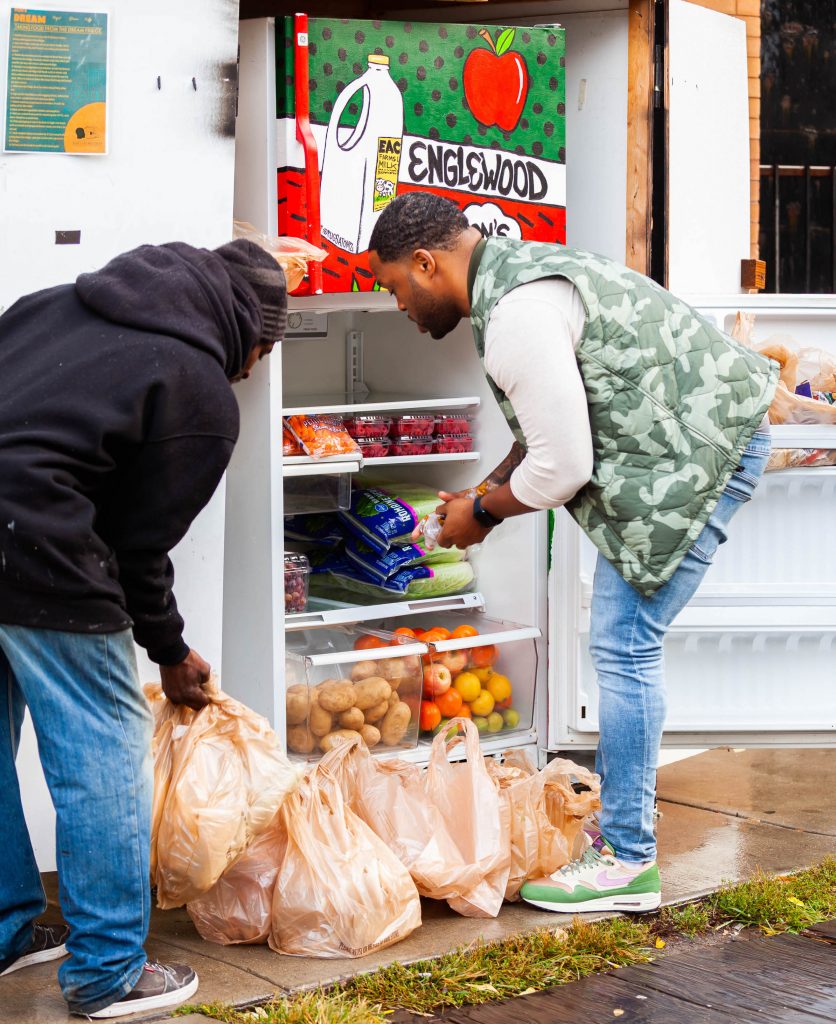
Dion Dawson’s day starts around 8 am at the corner of 59th Street and Racine Avenue in Chicago’s Englewood neighborhood. Most days, his six-year-old son Bryson accompanies him, eager to help stock the community fridge labeled with “FREE FOOD” in sky blue letters. Usually, the area’s residents have already gathered around the fridge, which has been spray-painted with happy cows, bright red apples, yellow corn and potatoes, as Dawson puts in oranges, lettuce and strawberries. He hands out bananas and grapes, too.

“Always grapes,” he emphasized. “When I grew up food insecure, I never got to eat fresh grapes, ever. So I make sure we always have fresh grapes. That may not be cost effective, but it makes a difference.”

Dawson sets up the Chicago nonprofit Dion’s Chicago Dream and the community fridge in 2020. He added a free weekly produce home delivery service in 2021. Both address the lack of access to fresh fruit and vegetables endemic to food deserts — areas that lack supermarkets and are typically low-income. They are also inspired by Dawson’s past food insecurity as well as his negative experiences with donation boxes from food banks.

“More than 500,000 Chicago residents live in a food desert,” Dawson says, citing American Community Survey data. “More than half of our residents will be food insecure in our community within this year.”

Englewood community fridge
Neighbors can pick up free produce from the Englewood community fridge anytime. Credit: Amber Marie Green Photography

The Englewood fridge is accessible all day, unmanned, for anyone to take as much fresh produce as they like. “The opportunity to consume fresh fruits and vegetables is not something that I am used to,” said one resident, Terence. “I feel sometimes that I don’t deserve it because no one has cared to offer it to us consistently.”

Dawson spent six years in the Navy and experienced 14 years of homelessness before and after his service. “I grew up with three brothers and a single mom who struggled with addiction,” he says via Zoom from his mother’s house in Englewood. His mother recently survived kidney cancer, and he made her the executive assistant of his nonprofit. “We often went hungry or lived three days on potato chips,” Dawson remembers.

What stuck with him most, though, wasn’t just the hunger but the dehumanization he felt at the food banks. “I’ll never forget that horrible soaking wet day when my family had to wait outside for hours as the rain poured down on us, only to be rewarded with expiring fruits, unlabeled canned goods and a box of raisins.” Maybe worse than the food was the shame he associated with the experience. “Nobody looks you in the eye. Nobody connects with you. You are given a box of discarded food, most of it food you wouldn’t normally eat, and it is such a humiliating experience.”

This is the reason he decided to do everything differently with Dion’s Chicago Dreams. “We focus on the recipient instead of the donor’s experience. We connect with people.”

His project was launched as a spontaneous idea when a friend challenged him in 2020 with: “What are you going to do for Juneteenth?” Dawson responded on a whim, “I’m going to feed 100 families.” He raised $2,500 on GoFundMe, bought 100 pounds of food and fed 96 families. “After that, I said, let’s go for it, and I started Dion’s Chicago Dream.” He taught himself how to set up a nonprofit, and in September 2020, he began stocking the community fridge in Englewood, working out of his car.

“Since its inception, Project Dream Fridge has provided more than 36,000 pounds of fresh food and water,” Dawson says, at a weekly cost of $550. Through the weekly home deliveries, he and his seven employees now deliver to 375 homes per week, feeding 2,000 people in 23 neighborhoods with 15,000 pounds of fresh produce per month. “We move more produce than Walmart,” he quips, at a cost of about $1,000 per family per year. “We have that tangible impact.”

Supported by donations from locals like rapper G Herbo and organizations such as the Obama Foundation, what he delivers is exclusively fresh produce. Bananas, cucumbers, spinach, mango, whatever is in season and available from its wholesale supplier, JAB Produce. “The food is wow!” 65-year-old Alice Lesure says while she is preparing collard greens and cabbage from the most recent delivery for lunch. She has known Dion Dawson for “20-plus years” because her son went to school with Dawson, and she reached out to the nonprofit through her son. “I’m on disability. I eat healthier now and don’t have to worry about buying fresh

Read More