River North restaurants cut hours more than any area in US during COVID: survey

Restaurants in River North cut their operating hours more during the COVID-19 pandemic than restaurants in any other part of the country, according to a new survey.

Some restaurants have stopped serving lunch altogether. Some restaurants are now closed several days a week to remain profitable.

On average, River North restaurants in the 60654 ZIP code cut 20.2 hours per week between October 2019 and October 2022, according to an analysis by Datassential, a Chicago-based firm.

That figure massively outpaces the national average drop of 6.4 hours per week over the same period, the analysis shows.

In terms of operating hours cut, New York City has 12 of the top 15 ZIP codes — but the River North was higher than any of them, taking the top spot.

But why were River North restaurants the most vulnerable?

Restaurant owners point to several factors: inflation, a persistent lack of workers, changing consumer habits. But the biggest issue may be workers’ sluggish return to downtown.

“River North got hit the hardest because it was so close to the financial district — but it never really brought people back to work,” said Sam Sanchez, CEO of Third Coast Hospitality.

Sanchez hasn’t held lunch service at his two River North restaurants, Tree House Chicago and Moe’s Cantina, since COVID hit.

Moe's Cantina, 155 W. Kinzie St.

Moe’s Cantina, 155 W. Kinzie St.

Sanchez said he’d go out of business if he didn’t cut those lunch hours, since labor made up so much of his operating costs. And he hasn’t seen the crowds return for happy hour either.

“I’m not going to open for lunch if I only have 10, 20, 30 tables throughout the lunch period,” he said. “And people don’t go out late at night on Monday, Tuesday, Wednesday. So you don’t open” then.

Restaurants are also closing earlier nationally. On a typical Wednesday evening, about 41% of restaurants are open at 9:45 pm, compared to 56% in 2019, the survey found.

Sanchez hopes more people return to work in the spring.

“We need a density of people. We need traffic. We need new ideas. We need to draw people to River North,” he said.

Workers have remained stubbornly absent from the central business district since COVID hit nearly three years ago.

The office occupancy rate is still less than half of what it was in 2019, and pedestrian traffic is two-thirds what it was then, according to an analysis by the Chicago Loop Alliance. Developers seeking to adapt to the new normal have proposed turning empty office space into apartments to revive the once-bustling La Salle Street corridor.

One positive sign: Business events and conventions have begun returning to Chicago, Sanchez said.

But he’s preparing for a rough winter. In January and February, he’ll probably keep his River North restaurants open only three days a week.

Aside from a lack of customers, restaurants have been reeling from a shortage of workers.

“A lot of owner/operators are saying to me, ‘We really need more team members,’” said Sam Toia, president of the Illinois Restaurant Association. “When you’re lacking team members, you’ve got to cut your hours.”

Across the country, two out of three restaurants were understaffed in August, according to the National Restaurant Association.

Kevin Vaughan owns the Emerald Loop, 216 N. Wabash Ave., and the Chicago Brewhouse on the Riverwalk. He, like others, has struggled to attract workers.

“It’s a tough business to be in right now. We work nights and weekends. It’s a tough, customer-facing job,” he said.
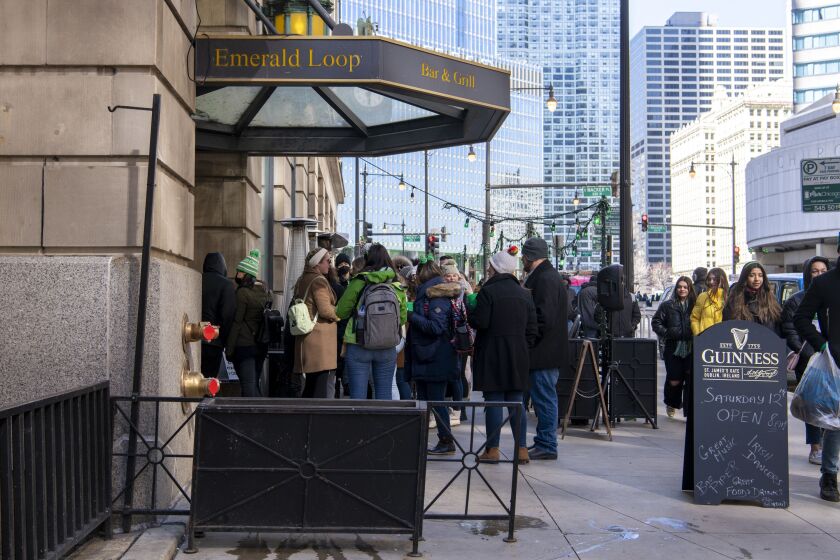
Dozens of people line up outside the Emerald Loop Bar and Grill, after the St.  Patrick's Day Parade in downtown Chicago, Saturday, March 12, 2022.

Dozens of people line up outside the Emerald Loop Bar and Grill, after the St. Patrick’s Day Parade in downtown Chicago in March.

Tyler Pasciak LaRiviere/Sun-Times

Many of those potential workers are opting to work in the gig economy, he said.

“We offer a lot of flexibility, but the gig economy offers even more flexibility,” said Vaughan.

He’s reached out to community colleges to attract workers so he won’t have to cut hours. “About 50% reply to interview requests. And when we schedule interviews, we’re batting about 50% after that,” Vaughan said.

The Illinois Restaurant Association has tried to address the worker shortage by advocating for immigration reform. Declining immigration under the last two presidential administrations may be behind the lack of available workers, Toia said.

He wants working visas for hospitality workers, just as the US does for farm workers. That idea could gain bipartisan support because this staffing problem hits red and blue states alike, he said.

Restaurants have also cut their hours to accommodate changing consumer habits. Customers are ordering takeout more and preferring to eat at home, either as a way to save cash or remain COVID-safe.

Takeout and delivery rates have nearly doubled since before the pandemic, and that has cut into restaurants’ revenue, Toia said.

Ordering takeout and delivery “was starting to become

Read More

Christkindlmarkt to feature authentic German wares, food from more than 50 vendors

“The first year, we had a blizzard. It started snowing on Friday and didn’t stop until Sunday. It was the coldest thing I’ve ever done. So, the following year, we decided to move into the Marriott, and that worked really well for us, but then we outgrew the Marriott. We usually have around 25 booths. Now, this year, we’ve doubled,” Zellner said.

German gift items will include ornaments, beer steins, pyramids and nutcrackers as well as other popular ideas such as T-shirts, floral décor and wooden toys. Hanover Winery will be serving and selling its signature wines.

“I love meeting all the people. We have 15 or 20 repeat vendors, and they’ve become like family. You get to know them and what they bring…All the people from Hamilton come out, and now, we realize we’re getting people from all over, not just from Hamilton. It’s really growing,” said Zellner.

The entertainment line-up will feature The Fest Meisters on Friday from 5 to 9 pm On Saturday, Gerhard Albinus will perform from 11:30 am to 2:30 pm Enzian German dancers will take the stage on Saturday from 3:15 to 4: 15 pm and The Klaberheads will headline the event on Saturday night from 5 to 9 pm

Food offerings will include selections from Wassler Meats and Servatii’s. Brats, metts and hot dogs will be available, along with sauerkraut, mashed potatoes and green beans. Servatii’s desserts will include cream puffs, apple and cherry strudel and chocolate mousse. Guests may purchase individual items and meals. There will also be German beer and wine as well as soft drinks and coffee available.

“This is a great way to kick off the holidays, and it will get everyone in the Christmas spirit,” said Zellner. “You can buy your Christmas presents, have a good meal and enjoy the German entertainment.”


How to go

what: Hamilton Christkindlmarkt

when: 5 to 9 pm Dec. 2, 11 am to 9 pm Dec. 3

where: Butler County Fairgrounds Event Center, 1715 Fairgrove Ave. and Ohio 4

Admissions: $1 admission for attendees ages 12 and older. Free parking.

more info.: sites.google.com/view/christkindlmarkt-hamiltonoh/home and on Facebook at www.facebook.com/profile.php?id=100067439631128

Read More

‘Surprisingly tasty’: putting Neanderthal cooking to the test | Neanderthals

Pity the Neanderthal chef. With only rudimentary cooking implements – a hot rock, some scraps of animal skin, perhaps a favored prodding stick, plus stones for pounding, cutting, scraping and grinding – their hands must have been a scarred mess, and the woodsmoke from the hearth must have played havoc with their eyes. However, according to research published this week, they did at least have access to a smörgåsbord of ingredients.

Gone is the stereotype of Neanderthals tearing into raw tubers or gnawing on a leg of roasted animal meat. Microscopic analysis of ancient food scraps unearthed from a hearth in Shanidar Cave, in Iraq, has provided the first real indication of complex cooking – and thus of food culture – among Neanderthals.

So, what did a Neanderthal meal taste like, and how easy was it to prepare? On a rainy afternoon in urban Bristol, I decided to find out.

According to Dr Ceren Kabukcu, of the University of Liverpool, who carried out the analysis, a typical dish would probably have contained a pounded pulp of pulses, nuts and grass seeds, bound together with water and flavored with bitter tannins from the seed coats of pulses such as beans or peas, and the sharp taste of wild mustard.

Ingredients: fava beans, lentils, almonds, pistachio nuts and yellow mustard seeds.
Ingredients: fava beans, lentils, almonds, pistachio nuts and yellow mustard seeds. Photo: Adrian Sherratt/The Guardian

Gathering such ingredients must have been time-consuming. “There are lots of species out at Shanidar in the savannah-type vegetation, and I’d guess the Neanderthals would have gathered whatever they came across and cooked with it,” said Prof Chris Hunt, of Liverpool John Moores University, who coordinated the excavation.

While lacking easy access to a savannah, I do have the convenience of several health food shops and a Turkish mini-mart within minutes of my house. Sadly, these didn’t stock terebinth (wild pistachio) or bitter vetch (a legume), but commercial raw pistachios and puy lentils provided acceptable substitutes.

Tucked away at the back of our larder, I found a half-empty packet of fava beans with a use-by data of 2010 – not quite neolithic, but ancient enough.

Using a pestle and mortar
Even using a pestle and mortar, grinding the ingredients together takes considerable effort. Photo: Adrian Sherratt/The Guardian

Kabukcu and Hunt suggested combining these – or other types of dried beans or peas (not marrowfat) – with an ancient whole grain such as spelt, einkorn wheat berries or barley, in default of grass seed. Neanderthals also used wild almonds and mustard seeds in their cooking, so I plumped for commercially grown equivalents.

Hunt counseled against the addition of salt. He said: “The Neanderthals had no easy access to salt in the region and would have had to cross the Zagros mountains to get to the nearest source. It is thought they got their dietary salt from eating the flesh of animals.”

The beans, lentils and grains all require soaking overnight – but what to soak them in? For authenticity, Hunt suggested using a leather pouch. But who, besides being an archaeologist, possesses a leather pouch? I contemplated using a scrap of artificial leather left over from Halloween, and even an old shoe. Eventually, I settled on a wooden bowl, having been assured that Neolithic wooden bowls might have been a thing.

The pattie cooking on a hot rock
The pattie cooking on a hot rock. Photo: Adrian Sherratt/The Guardian

With my ingredients soaked and softened, my mind turned to pounding. When the researchers attempted a similar feat near their excavation site in Iraq, they used locally sourced (and rather soft) limestone to pound and grind their ingredients. “It meant that the results were really rather gritty,” Hunt said.

Valuing the integrity of my teeth, I opted for a stone pestle and mortar. Even using this, grinding together the ingredients took considerable effort – particularly the wheat grains.

I combined this beige-brown mixture with several tablespoons of water to create a coarse sludge, which I carried outside to my fire pit and shaped into thin patties on top of a large rock surrounded by wood and charcoal buckets.

Sheltering under an umbrella while bitterly regretting not having access to a cave, I cooked my patties until their surfaces had turned golden brown and I was convinced the insides were thoroughly heated through. Some beans contain toxins that need to be destroyed through cooking, so anyone thinking about recreating this recipe should take care.

The result is nutty, with some bitterness, and peppery undercurrents
The result is nutty, with some bitterness, and peppery undercurrents. Photo: Adrian Sherratt/The Guardian

The result was

Read More